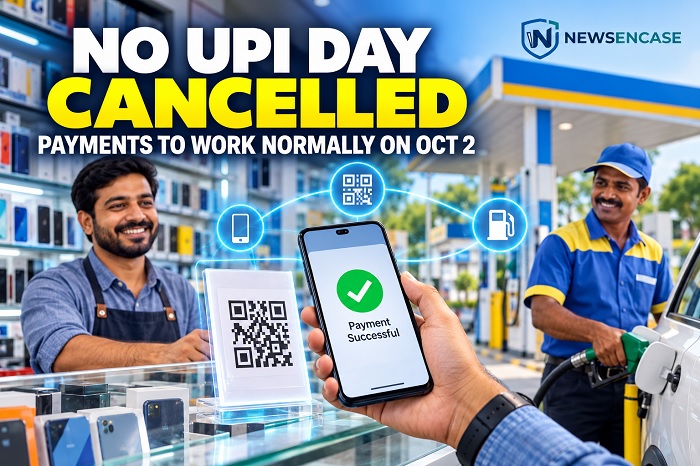
Traders have withdrawn the October 2 No UPI Day protest after meeting Finance Minister Nirmala Sitharaman. UPI will work normally, but retailers and petrol pumps continue to oppose the new MDR.
The proposed nationwide “No UPI Day” protest scheduled for October 2, 2026, has been withdrawn after representatives of leading trade organisations met Union Finance Minister Nirmala Sitharaman.
Customers will therefore be able to make UPI payments normally on Gandhi Jayanti. Banks, the National Payments Corporation of India and UPI applications have not announced any nationwide suspension of service for October 2.
However, the wider dispute over the new Merchant Discount Rate, or MDR, remains unresolved. Retailers and petrol-pump dealers continue to seek exemptions or changes before the revised charging framework is expected to take effect on October 15.
Why Traders Announced ‘No UPI Day’
The All India Mobile Retailers Association initially asked mobile-phone dealers to stop accepting UPI payments on October 2. Participating retailers planned to cover their QR codes and request cash or other payment methods.
The protest targeted the decision to introduce MDR on specified person-to-merchant UPI transactions above ₹2,000.
Retailers argued that the charge would reduce already narrow margins, particularly during the festive shopping season. AIMRA estimated that small mobile retailers processing between ₹5 lakh and ₹30 lakh in monthly UPI payments could face losses of approximately ₹2,000 to ₹12,000 a month.
Why the October 2 Protest Was Withdrawn
A delegation of around 20 trade leaders met Finance Minister Nirmala Sitharaman in New Delhi on September 30.
The delegation was led by Chandni Chowk MP and Confederation of All India Traders Secretary General Praveen Khandelwal. It included CAIT National President B.C. Bhartia, AIMRA Chairman Kailash Lakhyani, All India Consumer Products Distributors Federation President Dhairyshil Patil and All India Jewellers and Goldsmith Federation President Pankaj Arora.
Following the meeting, AIMRA and the All India Consumer Products Distributors Federation withdrew the “No UPI Day” call. Khandelwal said the decision followed constructive discussions and an assurance that the trading community’s concerns would receive due consideration.
The government reportedly reiterated its support for digital payments while assuring the delegation that the interests of merchants and other stakeholders would be considered.
The assurance does not amount to cancellation of the MDR framework. No final exemption or postponement was announced immediately after the meeting.
Will UPI Work on October 2?
Yes. UPI services are expected to operate normally on October 2.
The “No UPI Day” proposal concerned merchants voluntarily refusing UPI payments as a protest. It was never an NPCI, RBI or bank shutdown.
With the protest withdrawn, customers should be able to pay through UPI at shops, restaurants, fuel stations and other establishments. An individual merchant may still face a technical problem or choose another payment method, but there is no confirmed nationwide UPI closure.
What Changes From October 15?
Under the revised framework expected to take effect on October 15:
- Specified person-to-merchant UPI payments above ₹2,000 will attract an MDR of 0.4%.
- The charge will ordinarily be paid within the merchant-payment ecosystem—not directly by the customer.
- MDR will be capped at ₹300 for transactions of ₹75,000 or more.
- Person-to-person transfers will remain free regardless of the amount.
- UPI applications are prohibited from imposing hidden platform charges on customers.
- Banks have been advised to ensure that merchants do not pass the MDR directly to consumers.
- Mutual-fund, securities and stockbroker payments will attract a lower rate of 0.02%, capped at ₹300.
- Fuel, railways, telecom, insurance and agricultural-input payments above ₹2,000 will attract a flat ₹5 merchant charge instead of the regular 0.4% rate.
The government told the Supreme Court that approximately 96% of users would remain outside the charge under the applicable exemptions and limits.
Petrol-Pump Dealers Continue to Raise Concerns
The petrol-pump dispute is separate from the cancelled October 2 protest.
The Petrol Dealers Association of Mumbai has asked the RBI and Finance Ministry for a complete exemption. It previously warned that fuel retailers could stop accepting UPI payments from October 15 if their concerns were not addressed.
Association president Chetan Modi said digital payments account for more than 60% of fuel sales at participating outlets. Dealers argue that they invested in digital-payment infrastructure on the understanding that UPI would remain free of MDR.
Fuel prices and dealer commissions leave petrol-pump operators with limited flexibility to absorb additional costs or increase the final amount charged to customers.
The revised framework provides a concessional flat MDR of ₹5 for eligible fuel transactions above ₹2,000. However, petrol-pump associations continue to seek a complete waiver.
There is presently no confirmed nationwide announcement that petrol pumps will stop accepting UPI on October 2. Their warning concerns possible action from October 15 if the MDR dispute remains unresolved.
Retail and Apparel Bodies Oppose MDR
The Retailers Association of India has warned that transaction charges could encourage merchants to favour cash, particularly when festive-season purchases exceed ₹2,000.
The Clothing Manufacturers Association of India has also raised concerns about the timing, arguing that consumer-facing businesses are already dealing with weak demand and pressure on margins.
Retail representatives fear that even if customers are not formally charged, some merchants may increase prices, add unofficial surcharges or encourage buyers to use cash.
Supreme Court Refuses to Pause the Charge
The Supreme Court declined to stay the MDR framework on September 28. It sought responses from the RBI and NPCI on a petition challenging the legal basis and procedure behind the decision.
The court clarified that it was examining the legal incidence of the framework and had not delivered a final judgment on its validity.
The refusal to grant an interim stay means the October 15 implementation remains on course unless the government, NPCI or another competent authority changes the framework.
GST on MDR May Be Reviewed
MDR is also subject to 18% Goods and Services Tax, increasing the effective burden within the payment ecosystem.
The government is reportedly hopeful that the GST Council will review this tax. The council is scheduled to meet on October 7, although it has not been confirmed that the UPI issue will be included in its final agenda.
What Retailers Have Demanded
Trade organisations have asked the government to:
- Retain zero MDR for small and medium retailers
- Defer implementation during the festive season
- Introduce any MDR gradually instead of immediately imposing 0.4%
- Begin with a rate of 0.2% and increase it gradually
- Provide special exemptions for low-margin sectors
- Ensure charges are not transferred to customers
- Review the 18% GST applied to MDR
- Consult merchant organisations before future payment-policy changes
The withdrawal of the October 2 protest gives the government and trade bodies additional time to negotiate, but the underlying disagreement has not ended.
UPI’s Growing Importance
UPI processed nearly 25 billion transactions worth about ₹30 lakh crore in August 2026 and served more than 550 million users. It accounted for approximately 84% of India’s digital-payment transactions by volume.
The MDR debate centres on how to fund the infrastructure behind this enormous network without discouraging merchants and customers from using digital payments.
About the Author