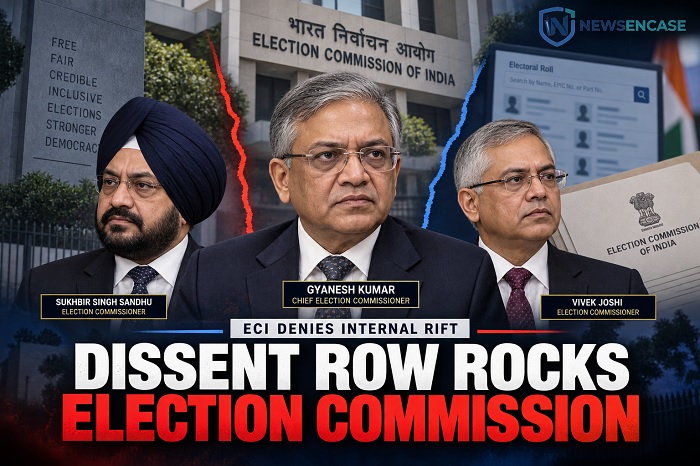
The Election Commission has rejected an Indian Express report claiming two commissioners raised repeated objections over SIR and voter-roll decisions.
The Election Commission of India has rejected a report claiming that two Election Commissioners repeatedly objected to important decisions involving electoral-roll revisions and voter-registration systems.
An investigation by The Indian Express claimed Election Commissioners Sukhbir Singh Sandhu and Vivek Joshi recorded objections on at least 14 occasions during a 10-month period. The newspaper said some decisions and communications were issued without their knowledge or approval.
The Election Commission responded that written observations, technical suggestions and differing views are normal components of its institutional decision-making process and should not be characterised as internal dissent.
What the Indian Express Report Alleged
According to the report, the objections concerned the Special Intensive Revision of electoral rolls, changes to Form 6 for new voters, access to the central electoral database and appeals involving voters in West Bengal.
The newspaper reported that Sandhu described changes made to Form 6 as “unauthorised and illegal.” The revised form reportedly required applicants to provide information about whether they or their parents or grandparents appeared in electoral rolls prepared during an earlier SIR exercise.
The report also claimed the two commissioners expressed concern about the “gradual centralisation” of the electoral-roll database and questioned whether statutory Electoral Registration Officers were receiving complete access to the software used to maintain voter records.
Sandhu and Joshi also reportedly approached the Cabinet Secretary over changes affecting oversight of the Election Commission’s information-technology systems.
Goa and West Bengal Cases Flagged
The investigation cited the example of 97 people in Goa whom local registration officers reportedly considered eligible but could not restore to the final electoral roll because the software lacked the required option.
Another issue involved appeals arising from West Bengal’s electoral-roll revision. Sandhu reportedly sought details about who authorised appeals challenging the inclusion of certain voters by judicial officers.
Under the 2023 law governing the Election Commission, its business should be conducted unanimously whenever possible. If the three commissioners disagree, a matter is decided according to the majority opinion.
Election Commission Denies Institutional Rift
The Election Commission said operational questions and suggestions raised during the drafting stage were standard administrative practices intended to protect voters’ rights.
It argued that highlighting selected internal notes while ignoring its broader record presented only part of the picture. According to the Commission, the final decisions concerning the SIR and other electoral reforms were taken unanimously by the full panel.
The ECI also defended its ECINet platform, saying it operates with data-security protocols and audit controls designed to prevent unauthorised changes. It maintained that statutory officers continue to exercise their legal powers concerning voter registration and deletion.
The controversy has triggered political criticism, but the reported internal communications and the Commission’s rebuttal present sharply different interpretations of the same institutional discussions.
About the Author