
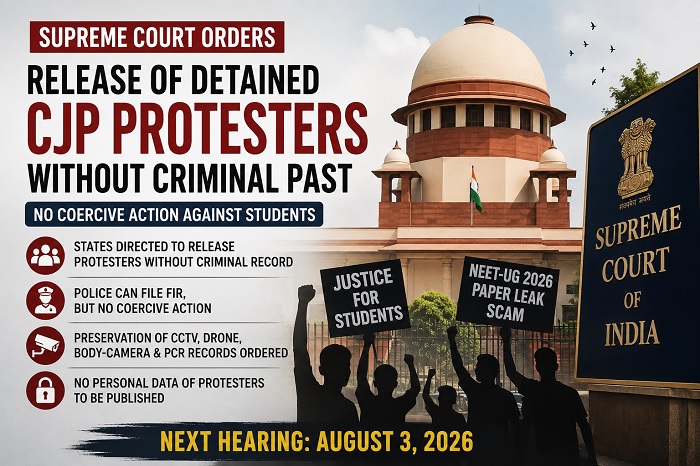
The Supreme Court has directed states to release detained CJP protesters with no criminal history, barred coercive action against students, and ordered preservation of evidence related to the nationwide NEET-UG 2026 protest crackdown.
New Delhi : In a significant interim order, the Supreme Court on Tuesday directed all states to release students detained during the Cockroach Janta Party (CJP)-led protests if they have no prior criminal record. The Court also instructed police authorities not to take any coercive action against such protesters while allowing the registration of FIRs where required.
The directions were issued by a bench comprising Chief Justice of India Surya Kant, Justice Joymalya Bagchi, and Justice V. Mohana while hearing multiple petitions alleging excessive police action during demonstrations over the alleged NEET-UG 2026 paper leak.
The protests, which began at Jantar Mantar in New Delhi, later spread to several states, including Maharashtra, Bihar, Gujarat, Assam, West Bengal, and Kerala. Petitioners claimed that students were subjected to lathi charges, tear gas, pellet guns, and electric weapons, alleging violations of their constitutional rights under Articles 14, 19, 20, and 21.
Court Calls for Independent Probe
Observing that the allegations raised before it prima facie warrant an independent and impartial investigation, the Supreme Court ordered authorities to preserve all evidence related to the protests.
The Court directed police departments across the country to safeguard:
- CCTV footage
- Drone recordings
- Body-camera footage
- Wireless communication records
- Police Control Room (PCR) logs
It also ordered that digital data of protesters must be preserved and should not be released publicly, emphasizing that no personal information or identities of protesters should be disclosed.
Senior Officials Summoned
The Supreme Court has asked the Chief Secretaries and Directors General of Police (DGPs) concerned to appear at the next hearing scheduled for August 3, 2026, as it continues to monitor the matter.
The case is expected to play a key role in determining the legality of the police response to the nationwide student protests and the demand for accountability over the alleged examination irregularities.
About the Author


