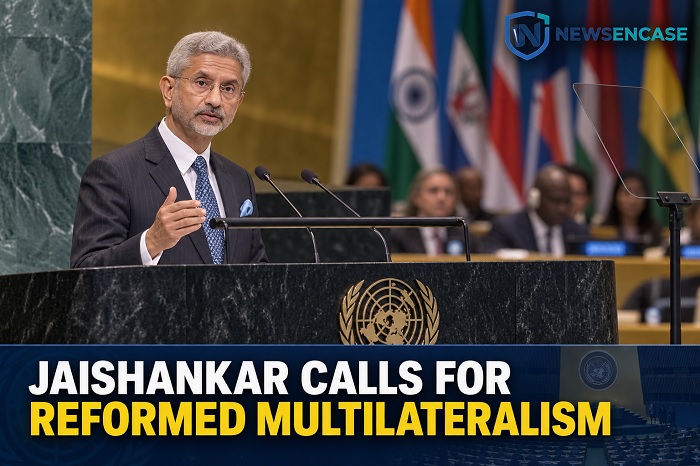
S. Jaishankar has called for reformed multilateralism, transparent global institutions and coordinated action on food, fuel, finance and security challenges.
External Affairs Minister S. Jaishankar has called for a stronger and more representative multilateral system, warning that intensifying geopolitical competition and conflicts are placing the global order under severe stress.
Speaking at the inaugural Partners for Multilateralism, International Law, Peace and Prosperity Summit in New York, Jaishankar said international cooperation was essential to address challenges that no country could resolve independently.
The summit was held on the sidelines of the 81st United Nations General Assembly. Jaishankar co-chaired the meeting with European Council President António Costa.
Global Order Facing Multiple Pressures
Jaishankar said the long-anticipated redistribution of global power was occurring amid growing rivalry, armed conflicts and disruptions to trade and supply chains.
He argued that cooperation remained essential across areas including international security, climate action, development finance, emerging technologies, counterterrorism, disaster preparedness and pandemic response.
“The future of peace and international security” depends upon countries demonstrating a willingness to cooperate, Jaishankar said, according to reports from the summit.
The minister said the international community should protect the achievements of existing institutions while continuing to pursue improvements.
Jaishankar Flags ‘4F Crisis’
Jaishankar highlighted the interconnected challenges involving food, fuel, fertiliser and finance, describing them collectively as the “4F crisis.”
He said these pressures could not be allowed to develop without coordinated international action, particularly because they disproportionately affect developing countries and vulnerable populations.
The minister also called for global frameworks and safeguards governing emerging technologies and other rapidly developing capabilities.
Countries should reduce their exposure to strategic chokepoints, market dominance and supply disruptions by diversifying production and building more resilient supply chains, he added.
India Seeks More Representative Global Institutions
Jaishankar said stronger multilateralism would require reforms that make international institutions more participatory, transparent and responsive to contemporary realities.
India has repeatedly argued that global bodies created after the Second World War no longer adequately represent current economic and demographic realities, particularly the growing importance of Asia, Africa and the Global South.
The country has also sought permanent membership of the United Nations Security Council as part of a wider reform of the UN system.
During a separate meeting held alongside the General Assembly, the Visegrád Group—comprising Poland, Hungary, Slovakia and the Czech Republic—supported India’s bid for permanent UNSC membership.
Respect for International Law Essential
Jaishankar stressed that any renewed multilateral approach must remain grounded in respect for international law, established rules and widely accepted norms.
He said countries sharing common concerns should be willing to form practical coalitions instead of waiting for comprehensive solutions to every global dispute.
Specific humanitarian, economic or security issues arising from continuing conflicts could still be addressed even when broader peace settlements remained difficult, he said.
The P4M initiative seeks to strengthen cooperation across regional and political divisions while supporting a more effective United Nations system.
Jaishankar said transparent decision-making and broader participation could restore confidence in multilateral institutions and create greater optimism about their ability to respond to global crises.
About the Author