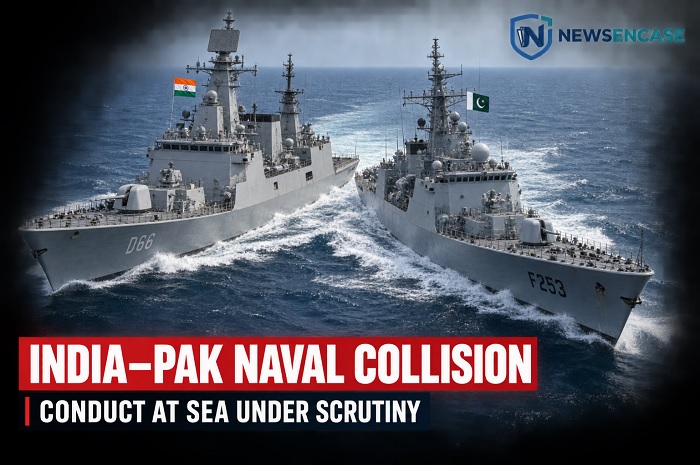
The India-Pakistan naval collision in the Arabian Sea has raised questions about safe navigation, the 1991 agreement and professional conduct at sea.
The collision involving Indian and Pakistani naval vessels in the North Arabian Sea has renewed concerns about maritime professionalism, crisis management and the risks created when warships from rival nuclear-armed countries operate in close proximity.
The incident occurred on September 15, 2026. India said Pakistan Navy vessel PNS Hunain approached a frontline Indian warship at high speed and manoeuvred unsafely, causing a minor collision. The Indian vessel reportedly remained operational, while PNS Hunain was said to have returned to port.
Pakistan presented a sharply different account, alleging that the Indian vessel acted aggressively during a Pakistani naval exercise. The two countries also disagreed over whether the collision occurred in international waters or Pakistan’s exclusive economic zone.
No major damage or casualties were reported. Both governments summoned each other’s diplomats and lodged formal protests, according to the Associated Press.
Why the Three-Nautical-Mile Rule Matters
India accused the Pakistani vessel of violating Article 10 of the 1991 bilateral agreement covering military exercises, manoeuvres and troop movements.
The provision requires Indian and Pakistani naval vessels operating in international waters to maintain a minimum distance of three nautical miles—approximately 5.6 kilometres—from each other.
That distance is an important safety mechanism rather than a symbolic diplomatic measure. It gives ships time to identify movements, communicate warnings and alter course before an encounter becomes dangerous.
A sudden close approach can be interpreted as surveillance, intimidation or preparation for hostile action. Between countries with a history of military conflict, even a navigational mistake can quickly become a diplomatic or security crisis.
Professionalism Extends Beyond Combat Readiness
A modern navy is assessed not only by its weapons, warships and combat capability but also by its seamanship.
Professional conduct requires vessels to maintain a safe speed, make predictable course changes, communicate clearly and follow international collision-prevention rules. Commanders must prevent tactical shadowing or intelligence gathering from creating an avoidable navigational emergency.
Determining responsibility for the latest collision will require more than competing official statements. Radar tracks, bridge records, radio communications and navigational data would provide a clearer picture of the vessels’ positions, speeds and warnings before impact.
Until such evidence is made public, the precise sequence of events remains disputed.
The 2011 INS Godavari–PNS Babur Incident
The collision has revived memories of a similar confrontation in June 2011 involving INS Godavari and PNS Babur in the Gulf of Aden.
India alleged that PNS Babur approached the Indian frigate dangerously at high speed and damaged its flight-deck safety net. Pakistan accused the Indian ship of interfering with an operation involving the formerly hijacked merchant vessel MV Suez.
As with the latest encounter, the two sides offered opposing accounts. The recurrence demonstrates why agreed separation distances and reliable ship-to-ship communication remain essential.
Reports claiming that footage of the 2011 collision showed the September 2026 incident were incorrect. A fact-check confirmed that the circulating video was about 15 years old and unrelated to the latest confrontation.
Humanitarian Operations Present a Broader Picture
The conduct of the two navies cannot be judged solely through confrontational encounters.
In January 2024, INS Sumitra rescued crews from two hijacked fishing vessels, including 19 Pakistani nationals. Indian warships have also conducted major anti-piracy operations and provided medical assistance to injured foreign sailors, including a Pakistani fisherman treated by the crew of INS Trikand in 2025.
Pakistan’s navy has also conducted humanitarian missions involving Indian citizens. In May 2026, it responded to a distress call from the Indian vessel MV Gautam after the ship suffered a serious technical failure in the Arabian Sea. Six Indians and one Indonesian received food, medical care and technical assistance, Reuters reported.
These operations show that both forces are capable of putting maritime safety ahead of political rivalry. The important distinction is therefore not simply between two national navies, but between professional and dangerous behaviour during individual encounters.
Collision Offers a Warning for Both Countries
India and Pakistan operate in strategically important waters carrying commercial shipping, energy supplies and international naval deployments. Unsafe manoeuvring in this environment can endanger military personnel and nearby civilian vessels while creating the risk of unintended escalation.
The latest collision should prompt both countries to strengthen bridge-to-bridge communication, review encounter procedures and reaffirm the three-nautical-mile rule.
Naval capability is demonstrated not only by how a warship confronts an adversary, but also by whether its crew can exercise restraint, protect lives and prevent an avoidable incident from becoming a wider conflict.
About the Author