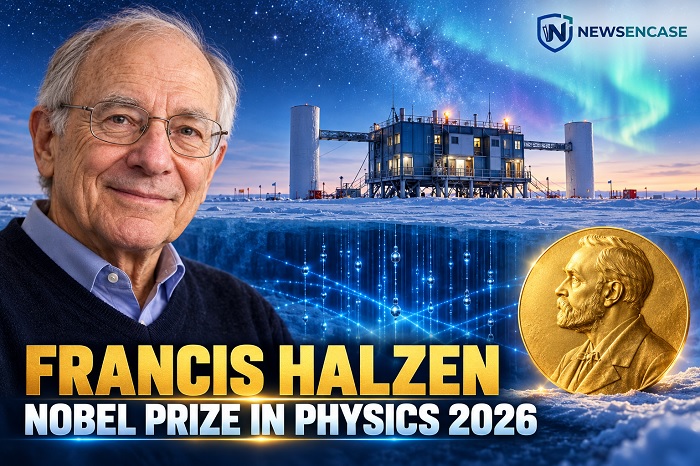
Francis Halzen wins the 2026 Nobel Prize in Physics for his IceCube contributions and the discovery of high-energy cosmic neutrinos.
Stockholm: Physicist Francis Halzen has won the 2026 Nobel Prize in Physics for his decisive contributions to the IceCube Neutrino Observatory and the discovery of high-energy neutrinos of astrophysical origin. The Royal Swedish Academy of Sciences announced the award on October 6.
Halzen, a professor at the University of Wisconsin–Madison, helped turn Antarctic ice into an extraordinary instrument for studying the universe. He is the principal investigator of IceCube, an observatory operated by an international scientific collaboration.
What Are Neutrinos?
Neutrinos are particles that rarely interact with matter, earning them the nickname “ghost particles.” Vast numbers pass through Earth without being detected. Occasionally, however, a neutrino interaction produces particles whose light can be recorded by specialised sensors.
Halzen recognised that the deep ice at the South Pole could provide a vast detection medium, helping scientists capture signals from exceptionally energetic cosmic events.
How IceCube Studies the Universe
IceCube uses thousands of light sensors embedded in approximately one cubic kilometre of Antarctic ice. By recording rare interactions, researchers can investigate neutrinos arriving from distant cosmic sources.
In 2013, the collaboration announced its first detection of high-energy neutrinos from beyond the solar system. The discovery opened a new way to explore the universe alongside conventional telescopes and other astronomical instruments.
Unlike electrically charged cosmic rays, neutrinos travel almost undisturbed through space. Their arrival directions can therefore help researchers investigate where powerful cosmic particles originate.
The award recognises Halzen’s scientific vision and leadership in developing a new approach to astronomy—one that examines the universe through particles as well as light.
About the Author