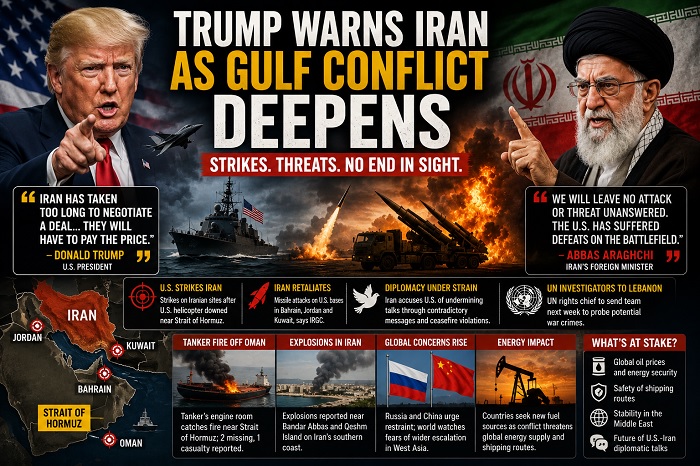
Washington/Tehran: Tensions between the United States and Iran escalated sharply on Wednesday as President Donald Trump warned Tehran it would “pay the price” for delaying negotiations, while Iranian officials vowed to respond forcefully to any future attacks.
The latest exchange came after the United States launched airstrikes on Iranian targets following the downing of a U.S. Army helicopter near the Strait of Hormuz. Iran retaliated with missile attacks targeting U.S.-linked facilities in Bahrain, Jordan and Kuwait, raising fears of a wider regional conflict.
Trump Issues Fresh Warning
In a post on Truth Social, President Donald Trump accused Iran of taking too long to negotiate a deal with Washington and claimed the country’s military capabilities had been severely weakened.
Trump stated that Iran’s armed forces had suffered significant losses and warned that Tehran would now face consequences for failing to reach an agreement earlier.
Iran Accuses U.S. of Undermining Diplomacy
Iran’s Foreign Ministry responded by accusing the United States and Israel of damaging diplomatic efforts through military action and repeated ceasefire violations.
Foreign Ministry spokesperson Esmaeil Baghaei said meaningful negotiations require stability and warned that continued military operations were making diplomatic progress increasingly difficult.
Tehran also urged Gulf nations to prevent their territories from being used for military operations against Iran, describing it as both a legal and moral responsibility.
Missile Strikes and Regional Security Concerns
Iran’s Islamic Revolutionary Guard Corps (IRGC) claimed responsibility for missile attacks targeting U.S. military facilities in Jordan. Jordanian authorities confirmed intercepting five missiles headed toward the Al-Azraq area, reporting no casualties or major damage.
Meanwhile, fresh explosions were reported near Iran’s southern coast, including areas around Bandar Abbas and Qeshm Island near the Strait of Hormuz, a critical route for global energy supplies.
International Community Calls for Restraint
Russia and China expressed concern over the escalating conflict and urged both sides to exercise restraint. Moscow called for an immediate halt to military actions, while Beijing warned against further escalation in West Asia.
The United Nations also announced plans to send investigators to Lebanon to examine potential violations of international law linked to the broader regional conflict.
Energy and Maritime Risks Grow
The conflict is beginning to affect global energy markets and shipping routes. A tanker fire reported off the coast of Oman and disruptions around the Strait of Hormuz have increased concerns about oil supply security.
Several countries are now exploring alternative energy sources amid fears that prolonged instability could disrupt one of the world’s most important oil transit corridors.
As military exchanges continue and diplomatic talks remain uncertain, global attention remains focused on whether Washington and Tehran can prevent the crisis from spiraling into a larger regional war.
About the Author