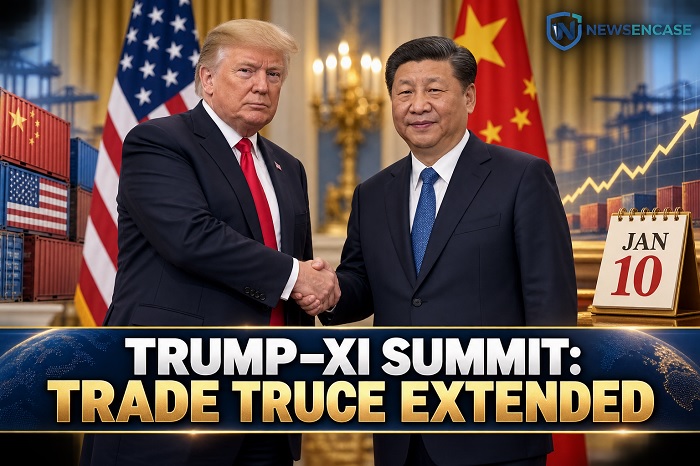
Donald Trump and Xi Jinping opened a Washington summit focused on trade, AI and Taiwan as the US-China tariff truce was extended to January 10.
US President Donald Trump welcomed Chinese President Xi Jinping to the White House on September 24 for a high-stakes summit focused on trade, artificial intelligence, Taiwan and the Iran conflict.
The Washington meeting—Xi’s first visit to the US capital in more than a decade—featured elaborate ceremonies intended to project stability despite the continuing strategic rivalry between the world’s two largest economies.
No major diplomatic breakthrough had been announced immediately after the bilateral talks. However, US Treasury Secretary Scott Bessent said the two countries had agreed to extend their trade truce until January 10, 2027.
Trump Gives Xi Rare Ceremonial Welcome
Trump and First Lady Melania Trump personally received Xi and Chinese First Lady Peng Liyuan at Joint Base Andrews on September 23.
The welcome included a red carpet, national anthems, an honour cordon and a military flyover. Trump’s decision to meet Xi at the airport was an unusual gesture for an American president and demonstrated the diplomatic importance Washington attached to the visit.
A second ceremony was held at the White House, followed by bilateral discussions and a military review in the Rose Garden.
Trump described his relationship with Xi as a “truly great friendship” and said the summit would address security, technology and what he calls “super intelligence.”
Xi said competition between China and the United States should remain healthy. He called for Chinese businesses to receive fair treatment in America while saying US companies remained welcome in China.
Trade Truce Extended Until January
The most concrete development surrounding the summit was the extension of the US-China trade truce from November 10 to January 10.
The arrangement prevents the immediate return of the steep tariffs that previously exceeded 100% during the trade confrontation between the two countries.
Negotiators are continuing discussions involving Chinese purchases of American agricultural products, Boeing aircraft, liquefied natural gas and access to strategically important rare-earth minerals.
The relatively short extension indicates that Washington still wants Beijing to demonstrate progress on its earlier trade commitments.
Taiwan Emerges as Key Dispute
Xi urged the United States to oppose “Taiwan independence,” according to China’s official account of the meeting.
Beijing claims Taiwan as part of its territory and has repeatedly objected to American arms sales and political support for the self-governed island.
The White House had not immediately released a detailed account of the Taiwan discussion. No change in official US policy was announced.
AI and Military Communication Discussed
Artificial intelligence was another major subject. Trump indicated that he did not favour imposing broad new restrictions on AI development, despite concerns about the technology’s potential risks.
Xi said China and the United States had a responsibility to manage AI for beneficial purposes. He also called for regular communication between the two countries’ militaries to reduce the possibility of miscalculation or an unintended crisis.
Iran, technology restrictions and global security were also expected to feature in the talks. The summit appeared primarily intended to preserve diplomatic stability and keep negotiations moving rather than resolve the countries’ deepest disagreements.
About the Author