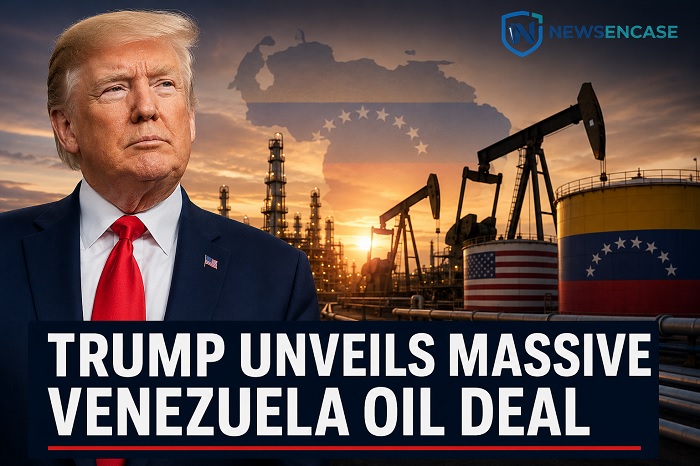
Washington: US President Donald Trump has announced a sweeping oil agreement with Venezuela, describing it as the “biggest oil deal in world history.” The proposed arrangement would give the United States majority control over the production of more than 65 billion barrels of proven Venezuelan oil reserves through a partnership with private businesses.
Trump said the agreement would more than double US-controlled oil reserves, strengthen American energy security and eventually help reduce fuel prices. However, the full legal and financial terms of the deal have not yet been publicly released.
What Does the US–Venezuela Deal Include?
According to Venezuela’s interim government, the agreement covers the development of 17 strategic oilfields, mainly located in the Orinoco Belt and Lake Maracaibo regions. Venezuelan officials are expected to grant new exploration and production rights to participating companies.
A US official cited by the Associated Press said Washington would partner with an unnamed private operator to establish a new company holding 100-year development rights. The United States would reportedly receive a 55% effective share of production, including an ownership stake and the right to purchase crude oil at cost.
Venezuelan interim President Delcy Rodríguez welcomed the agreement, saying it could attract approximately $100 billion in private investment and generate more than $209 billion in tax revenue for Venezuela. She said the project would help modernise the country’s oil industry and substantially increase production.
Will the Deal Lower Oil and Petrol Prices?
US Secretary of State Marco Rubio said the agreement could provide American refineries with a stable supply of lower-cost crude. Some of the oil may also be used to replenish the US Strategic Petroleum Reserve and meet military requirements.
However, analysts cautioned that consumers should not expect an immediate reduction in petrol prices. Venezuela’s oil infrastructure has suffered from years of inadequate investment, maintenance problems, sanctions and declining production. Repairing pipelines, power systems, refineries and export terminals could require billions of dollars and take several years.
Venezuela holds an estimated 303 billion barrels of crude reserves, among the largest proven reserves in the world, but currently produces only about 1.25 million barrels per day—far below its potential.
Legal and Investment Questions Remain
The deal may face legal and constitutional challenges because Venezuela has traditionally required state control over its core petroleum resources. Trump has not yet identified the participating companies or explained precisely how the United States will exercise control over the reserves.
Major American oil producers may also remain cautious because of Venezuela’s political uncertainty, damaged infrastructure and previous nationalisation of foreign-owned energy assets.
If fully implemented, the agreement could significantly expand US influence in Venezuela’s energy industry and reshape crude-oil supply patterns. Its impact on global oil prices will ultimately depend on how quickly investment arrives and whether production can be increased successfully.
About the Author