
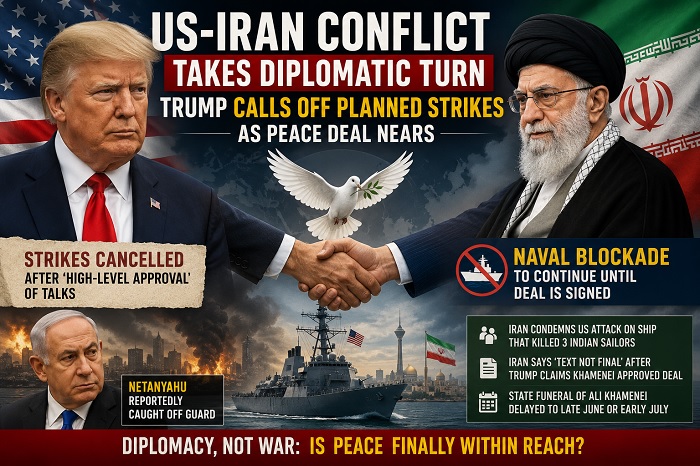
In a dramatic development in the ongoing US-Iran conflict, US President Donald Trump announced that planned military strikes against Iran have been cancelled after discussions received approval from Iran’s highest leadership levels, signaling a possible breakthrough in efforts to end tensions in the Middle East.
Posting on Truth Social, Trump stated that he had ordered the cancellation of scheduled strikes and bombings following the elevation of negotiations to Iran’s top leadership. He claimed that key elements of a proposed agreement had been approved in principle and in detail by multiple stakeholders, including the United States, Israel, Saudi Arabia, the UAE, Qatar, Turkey, Pakistan, Bahrain, Kuwait, Jordan, and Egypt.
Despite the diplomatic progress, Trump clarified that the US naval blockade against Iran will remain in place until a final agreement is formally signed. Details regarding the timing and location of the signing ceremony are expected to be announced soon.
Meanwhile, reports suggest that Israeli Prime Minister Benjamin Netanyahu was surprised by Trump’s decision to halt military action. According to Axios, Netanyahu has reportedly been seeking information from allies close to the Trump administration amid concerns that Israel was not fully informed about the latest negotiations between Washington and Tehran.
The apparent divergence in strategy comes as both leaders face domestic political pressures. Trump is reportedly seeking stability in global oil markets ahead of US midterm elections, while Netanyahu remains under pressure to achieve the objectives outlined at the start of the conflict.
Adding to regional tensions, Iran strongly condemned a reported US attack on a commercial vessel that allegedly resulted in the deaths of three Indian sailors. Tehran described the incident as evidence of what it called America’s continued policy of “state piracy” and armed aggression.
Iran also pushed back against Trump’s claim that Supreme Leader Mojtaba Khamenei had approved a peace proposal, with Iranian officials stating that the text under discussion is not yet final.
Separately, Tehran authorities announced that the state funeral for late Supreme Leader Ali Khamenei, who was reportedly killed in US-Israeli strikes at the outset of the conflict, has been postponed until late June or early July. Officials estimate that millions of mourners could attend the funeral ceremonies.
As diplomatic efforts continue, the region remains on edge, with global attention focused on whether the proposed agreement can successfully bring an end to the escalating conflict.
About the Author