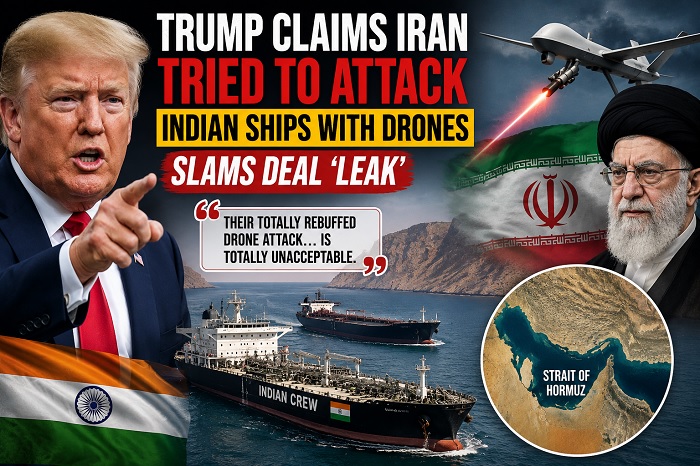
US President Donald Trump has accused Iran of attempting a drone attack on Indian-linked vessels near the Strait of Hormuz, calling the alleged incident “totally unacceptable” amid escalating tensions in the Middle East.
In a post on Truth Social, Trump claimed that Iran’s attempted drone strike against Indian ships departing the Strait of Hormuz had been successfully thwarted. He described the reported attack as a serious provocation and condemned Tehran’s actions.
The allegations come days after multiple commercial vessels with Indian crew members were targeted off the coast of Oman. In one of the incidents involving the Palau-flagged tanker MT Settebello, three Indian seafarers reportedly lost their lives.
Iran has strongly denied Trump’s accusations, dismissing them as baseless and politically motivated. Tehran alleged that the claims were intended to divert attention from recent US actions in the region.
India has expressed concern over the attacks on commercial shipping, describing the incidents as “deeply worrisome” and calling for an immediate end to threats against maritime security in the region.
Trump Rejects Iran’s Version Of Proposed Deal
Trump also criticized Iran over what he called a “leaked” version of a proposed US-Iran agreement aimed at ending hostilities in the Middle East. According to the US president, Tehran’s account of the negotiations does not reflect the actual terms discussed between the two sides.
He accused Iranian officials of acting in bad faith and stated that the leaked details “bear no relation to the truth.” Trump further warned that Iran needed to “get its act together” if progress toward an agreement was to continue.
JD Vance Denies Reports On Deal Terms
US Vice President JD Vance sought to clarify reports surrounding the proposed agreement, rejecting what he described as misinformation regarding financial concessions to Iran.
In a post on X, Vance said no cash payments or direct fund transfers would be made to Iran as part of any deal. He emphasized that the agreement was structured to protect US and allied interests while allowing economic benefits to flow only if Iran fulfilled its obligations.
Meanwhile, Iranian Foreign Minister Abbas Araghchi indicated that diplomatic efforts were making progress, stating that Washington and Tehran had never been closer to reaching an agreement to de-escalate tensions in the region.
The conflicting statements highlight ongoing uncertainty surrounding US-Iran negotiations as both sides continue efforts to reach a framework for regional stability while disputes over maritime security and military activities persist.
About the Author