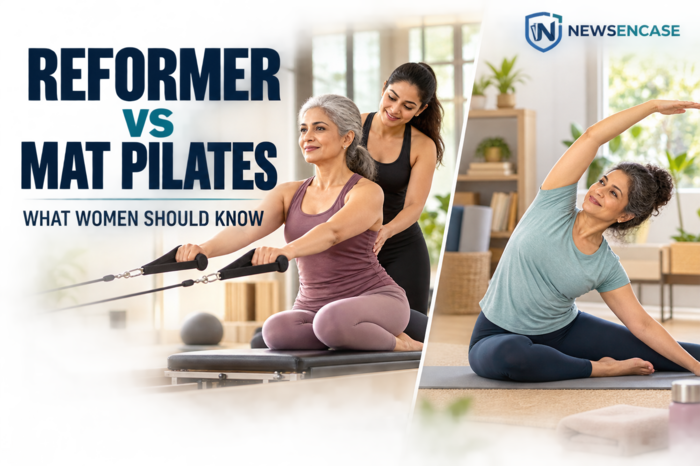
Reformer and mat Pilates can support strength, balance and mobility after menopause, but each has different costs and practical advantages.
Pilates is increasingly promoted to women after menopause because it combines controlled strength, balance, posture and breathing. A recent randomised trial compared supervised Reformer Pilates, home-based mat Pilates and lifestyle education among postmenopausal women with obesity.
Research in this area is still developing, and no single class can treat every menopause-related symptom. However, Pilates can form part of a broader activity plan when it is accessible and progressively challenging.
Reformer and Mat Pilates Compared
Reformer Pilates uses a spring-loaded machine that can provide assistance or resistance. The equipment allows many exercise variations, while instructor supervision can help with positioning and progression.
Mat Pilates uses bodyweight and sometimes small equipment such as bands or balls. It is less expensive, easier to practise at home and can still challenge the trunk, hips and shoulders.
The better choice depends on cost, access, confidence and personal preference. A supervised beginner class may help someone learn technique before moving to home sessions.
Pilates Is Only One Part of Healthy Ageing
After menopause, maintaining muscle and bone strength becomes increasingly important. Pilates contributes to strength and balance, but some routines may not provide enough resistance or impact to optimise bone health.
Women can combine Pilates with brisk walking and progressive resistance training using weights, machines or bands. Appropriate weight-bearing activity may also be useful when joint and bone health allow.
Anyone with osteoporosis, pelvic-floor symptoms, recent surgery, persistent back pain or balance problems should tell the instructor and seek qualified guidance. Exercises involving deep spinal flexion or twisting may require modification for some people.
Reformer Pilates is not automatically superior because it uses equipment, and mat Pilates is not automatically easier. The most effective option is a well-taught programme that can be continued, progressed and combined with other forms of movement.
About the Author