
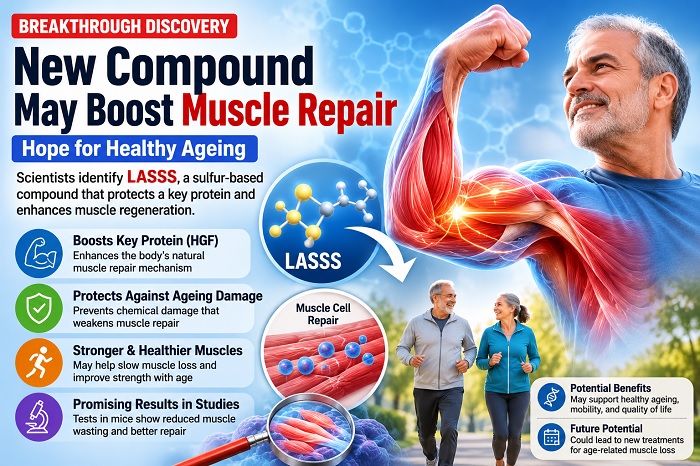
Researchers have identified a sulfur-based compound called LASSS that enhances muscle repair by protecting a key regenerative protein. The breakthrough could help combat age-related muscle loss and improve healthy ageing.
Washington, DC: Researchers have identified a promising sulfur-based compound called Lipoic Acid Trisulfide (LASSS) that may significantly improve the body’s ability to repair ageing muscles. The breakthrough, published in the journal Scientific Reports, could pave the way for new treatments aimed at slowing muscle loss and preserving strength in older adults.
The international research team, led by Professor Ryuichi Tatsumi of Kyushu University, found that LASSS enhances the activity of a key muscle repair protein, offering hope for healthier ageing and improved mobility.
How Ageing Weakens Muscle Repair
As people age, skeletal muscles naturally lose strength and mass. This process often leads to reduced mobility, increased fat accumulation in muscle tissue, fibrosis, and the loss of fast-twitch muscle fibers that support quick and powerful movements.
The researchers focused on Hepatocyte Growth Factor (HGF), a protein that activates satellite cells—the stem cells responsible for repairing damaged muscle tissue.
However, ageing causes HGF to undergo a chemical process called nitration, reducing its ability to bind with the c-Met receptor and weakening the body’s natural muscle regeneration process.
LASSS Creates a More Powerful Muscle Repair Signal
Scientists tested two sulfur-based antioxidant compounds—Glutathione Trisulfide (GSSSG) and Lipoic Acid Trisulfide (LASSS).
While both compounds reduced damage caused by nitration, LASSS delivered a surprising result.
Researchers found that:
- LASSS more than doubled HGF’s ability to bind with the c-Met receptor.
- The compound protected HGF from age-related chemical damage.
- Scientists believe LASSS may create an enhanced “Super HGF” that stimulates stronger muscle repair.
The research suggests LASSS not only works as an antioxidant but also improves the biological structure of HGF, making it significantly more effective.
Successful Results in Animal Studies
The team also tested LASSS in mice experiencing muscle atrophy caused by prolonged inactivity.
The treated mice showed:
- Lower levels of protein nitration.
- Better preservation of muscle repair signals.
- Improved resistance to muscle deterioration compared to untreated animals.
Researchers caution that additional studies in ageing animals and human clinical trials are still required before the compound can be developed into a medical treatment.
Potential Benefits Beyond Healthy Ageing
Scientists believe LASSS could eventually support treatments for:
- Age-related muscle loss (Sarcopenia)
- Muscle weakness caused by prolonged bed rest
- Recovery after injury or surgery
- Rehabilitation following long-term inactivity
- Muscle health in companion animals such as dogs and cats
If future clinical studies confirm its safety and effectiveness, LASSS could become an important tool for preserving muscle strength, mobility, and independence in ageing populations.
Research Published in Scientific Reports
The findings were published on July 24, 2026, in the peer-reviewed journal Scientific Reports. Researchers say the next phase will focus on testing LASSS in ageing animal models before progressing toward potential human clinical applications.
About the Author