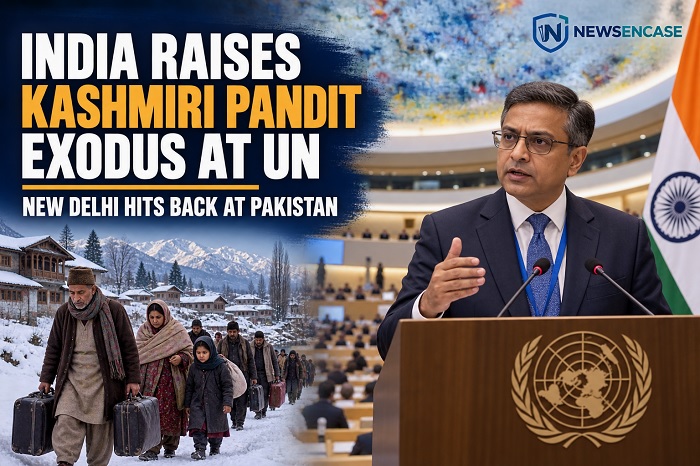
India told the UN Human Rights Council that Pakistan-backed terrorists forced Kashmiri Pandits from the Valley in 1990 and demanded that Islamabad vacate occupied parts of J&K.
India has raised the 1990 displacement of Kashmiri Pandits at the United Nations Human Rights Council, accusing Pakistan of arming and training the terrorists responsible for forcing the community from its homes in the Kashmir Valley.
Indian diplomat Kshitij Tyagi made the remarks while exercising India’s right of reply during the 63rd session of the UN Human Rights Council in Geneva.
His statement came after Pakistan raised Jammu and Kashmir and made allegations concerning minority rights in India.
India Blames Pakistan-Backed Terrorism
Tyagi rejected Pakistan’s allegations as an attempt at historical revisionism and said the large-scale displacement Pakistan referred to had occurred against Kashmiri Pandits in 1990.
“It happened in 1990 to the Kashmiri Pandits,” the Indian diplomat said, adding that they had been driven from their homes by terrorists whom Pakistan had armed, trained and sent across the border.
He said the same terrorist networks subsequently killed Kashmiris from different religious communities, including Muslims. India argued that a country accused of sponsoring those organisations was not in a position to demand an international inquiry into conditions in Jammu and Kashmir.
The forced migration of Kashmiri Pandits began amid rising militancy, threats and targeted killings in the Kashmir Valley around 1989–90. Thousands of families left their homes and relocated primarily to Jammu, Delhi and other parts of India.
India Asks Pakistan to Vacate Occupied Territory
India also reiterated its position that Pakistan should vacate the parts of Jammu and Kashmir that it controls.
Tyagi accused Islamabad of repeatedly using international forums to raise territorial claims while ignoring allegations involving terrorism, enforced disappearances and minority persecution within Pakistan.
Reports on the exchange said India described Pakistan’s control over parts of Jammu and Kashmir as a foreign occupation and rejected any Pakistani claim over the territory.
India maintains that the Union Territories of Jammu and Kashmir and Ladakh are integral parts of the country and that issues concerning them are internal matters.
Pakistan disputes India’s position and regularly raises Kashmir at the United Nations and other international forums.
India Questions Pakistan’s Minority-Rights Record
The Indian representative also contrasted the position of religious minorities in the two countries.
Tyagi said India’s minorities participate in elections, legislatures, courts and public institutions. He accused Pakistan of failing to protect Hindu, Sikh, Christian, Ahmadiyya, Shia, Ismaili and Hazara communities.
He referred to allegations of forced conversions, abductions, attacks on places of worship and the misuse of blasphemy laws in Pakistan. These allegations have also been raised separately by international human-rights organisations, although Islamabad disputes criticism of its record.
Kashmir Dispute Returns to UNHRC
The exchange marked another diplomatic confrontation between India and Pakistan at the Human Rights Council.
India has consistently argued that Pakistan uses the Kashmir issue to divert attention from cross-border terrorism and conditions in Pakistan-administered territories. Pakistan, meanwhile, continues to accuse India of human-rights violations in Jammu and Kashmir.
By highlighting the Kashmiri Pandit exodus, New Delhi sought to challenge Pakistan’s narrative and place terrorism-driven displacement at the centre of the Council’s discussion.
About the Author