Global oil prices surged Tuesday after escalating tensions between the United States and Iran raised fears of further supply disruptions in the Middle East.
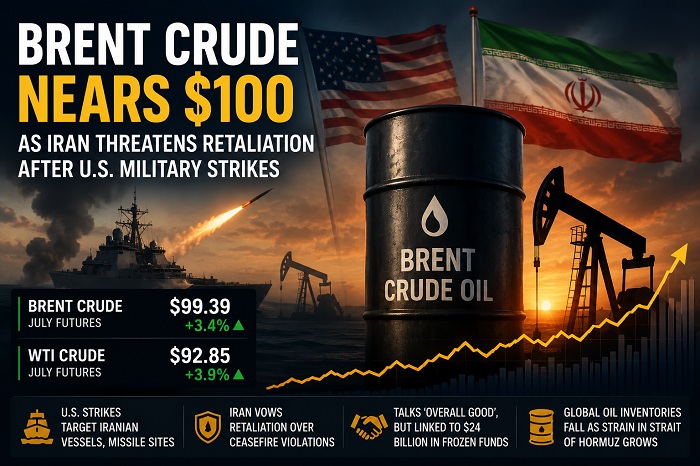
Brent crude futures climbed 3.4% to $99.39 per barrel during London trading, while U.S. West Texas Intermediate (WTI) crude traded at $92.85 per barrel. The sharp move came after fresh U.S. military strikes in southern Iran and renewed threats from Tehran fueled uncertainty across energy markets.
According to the U.S. military, “self-defense strikes” were carried out against vessels allegedly attempting to deploy naval mines, along with missile launch sites believed to threaten American forces in the region. The operations were conducted by the U.S. Central Command to protect troops from potential Iranian attacks.
In response, Iran’s Islamic Revolutionary Guard Corps warned it would retaliate against any violations of the current ceasefire arrangement. Iranian officials also claimed that U.S. drones and an F-35 fighter jet had entered Iranian airspace and were intercepted.
Despite the military escalation, signs of diplomacy remain. Iran’s semi-official Tasnim news agency described recent negotiations with Washington as “overall good,” though Tehran reportedly linked any future agreement to the release of $24 billion in frozen Iranian assets.
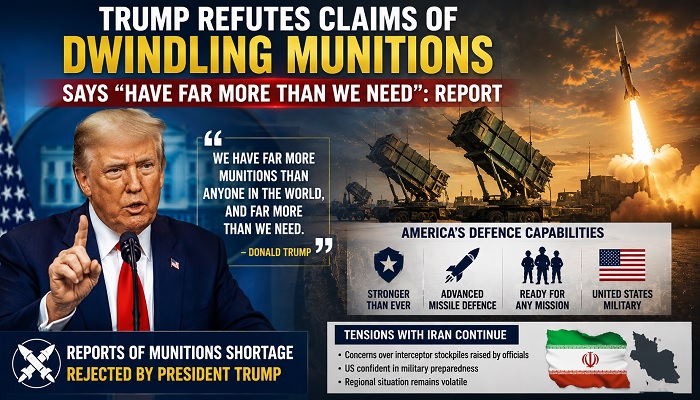
Meanwhile, U.S. President Donald Trump added further complexity to the geopolitical situation. In a social media statement, Trump said he had encouraged countries including Saudi Arabia, Qatar, Pakistan, Turkey, Egypt and Jordan to join the Abraham Accords aimed at strengthening ties with Israel.
Trump also stated that negotiations with Iran were “proceeding nicely,” but warned that military action could resume if talks fail. “It will only be a Great Deal for all or, no Deal at all,” he wrote.
Adding to bullish sentiment in oil markets, investment bank UBS said global crude inventories are falling rapidly amid continued disruptions in shipping through the Strait of Hormuz — one of the world’s most critical oil transit routes.
UBS estimated that global oil inventories declined by 246 million barrels in March and April combined, while cumulative production losses could surpass 1 billion barrels by the end of May. The bank noted that the market remains “strongly undersupplied,” with declining onshore crude and fuel inventories continuing to support higher prices.
The Strait of Hormuz remains a major concern for traders, as any prolonged disruption could significantly impact global energy supplies and fuel prices worldwide.
About the Author