New Delhi: The Central Government has exempted petrol blended with higher levels of ethanol from excise duty, marking a significant step in India’s transition toward cleaner and domestically produced fuels.
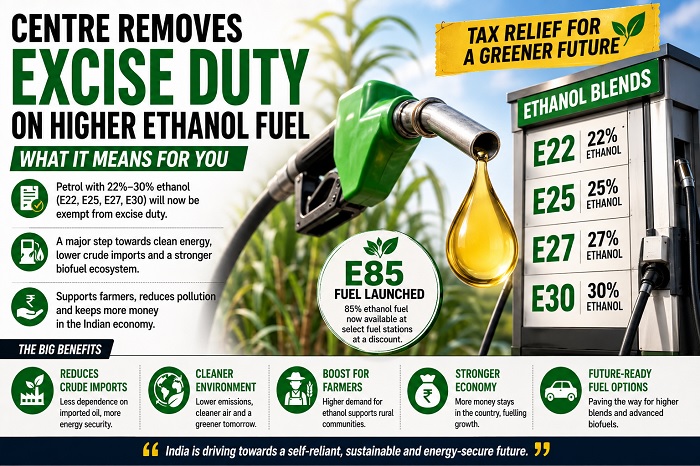
Under a recent government notification, petrol containing between 22% and 30% ethanol—including E22, E25, E27, and E30 blends—will no longer attract excise duty. The move extends tax incentives beyond the existing E20 fuel standard and signals India’s readiness for the next phase of its ethanol-blending programme.
Officials from the Ministry of Petroleum and Natural Gas clarified that the rollout of higher ethanol blends is still subject to extensive testing and consultation. They noted that while new fuel standards have been notified, no final decision has been taken regarding large-scale implementation.
The development follows the Bureau of Indian Standards (BIS) notification of fuel-quality standards for E22, E25, E27, and E30 petrol under IS 19850:2026. The standards establish technical specifications covering ethanol content, octane ratings, safety requirements, and testing procedures.
India’s ethanol blending programme has expanded rapidly in recent years. Blending levels rose from 10% in 2022 to nearly 18% by February 2025, helping reduce crude oil imports while boosting demand for domestically produced ethanol.
The government views ethanol as a strategic tool to reduce dependence on imported fossil fuels, lower carbon emissions, and generate economic benefits for farmers and rural communities. Union Minister Nitin Gadkari has repeatedly highlighted ethanol’s role in promoting green energy and strengthening India’s energy security.
The announcement comes shortly after the launch of E85 fuel, which contains 85% ethanol and is designed for flex-fuel vehicles. Introduced by Petroleum Minister Hardeep Singh Puri, E85 is currently available at select fuel stations and is being offered at a discounted price compared to E20 petrol.
While ethanol blending has sparked debates regarding vehicle compatibility and fuel efficiency, industry bodies maintain that approved blends are safe for use in compatible vehicles. The government continues to push forward with its biofuel roadmap as part of its broader clean-energy and import-reduction strategy.
About the Author