
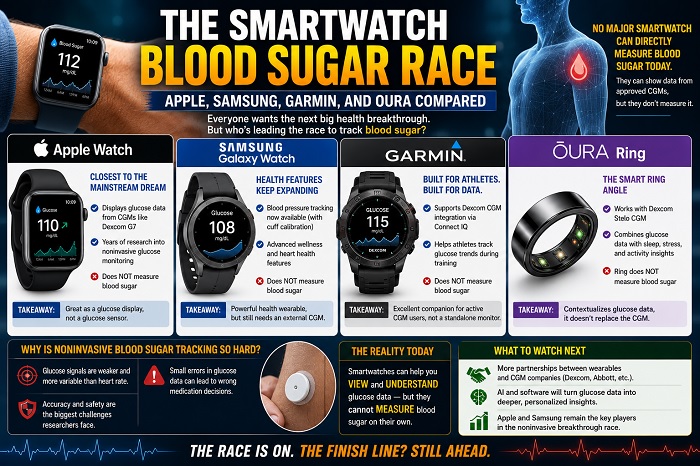
New Delhi: The race to bring blood sugar monitoring to smartwatches and wearable devices is intensifying, with major technology companies including Apple, Samsung, Garmin, and Oura investing heavily in health-focused innovations. However, experts say consumers should be cautious, as no mainstream smartwatch or smart ring can directly measure blood glucose levels without an external sensor.
While wearable devices have evolved to track heart rate, blood oxygen, sleep patterns, stress levels, and even blood pressure in some cases, glucose monitoring remains one of the industry’s biggest challenges.
No Smartwatch Can Directly Measure Blood Sugar
Despite growing interest in the technology, no major consumer smartwatch currently offers direct blood glucose measurement. Instead, devices rely on integration with Continuous Glucose Monitors (CGMs), which use a sensor placed under the skin to track glucose levels and transmit data to connected devices.
Health regulators have also warned users against relying on watches or rings that claim to independently measure blood sugar without approved medical sensors.
Apple Leads the Glucose Ambition
The Apple Watch is widely viewed as one of the strongest contenders in the non-invasive glucose monitoring race. Apple has spent years developing advanced health technologies and has already introduced features such as ECG monitoring, irregular heart rhythm alerts, fall detection, and sleep apnea notifications.
However, Apple Watch currently only displays glucose data from compatible CGMs like Dexcom G7 and does not measure blood sugar on its own.
Samsung Expands Health Tracking
Samsung has also invested significantly in health-focused features through its Galaxy Watch lineup. The company recently expanded blood pressure monitoring capabilities in several markets, but glucose tracking remains unavailable without external devices.
Industry observers believe Samsung continues to explore non-invasive blood sugar technologies, though no commercial solution has been announced.
Garmin Targets Athletes
Garmin’s approach focuses on athletes and fitness enthusiasts. The company’s devices can integrate with CGMs such as Dexcom, allowing users to view glucose readings during workouts and endurance training sessions.
While useful for monitoring performance and energy management, Garmin watches still rely entirely on external glucose sensors.
Oura Focuses on Metabolic Health
Smart ring maker Oura has positioned itself differently by combining glucose data from partner CGMs with insights related to sleep, activity, recovery, and stress.
Its partnership with Dexcom allows users to better understand how lifestyle habits affect metabolic health, though the ring itself does not measure glucose levels.
Why Glucose Monitoring Is So Difficult
Experts note that measuring glucose is far more complex than tracking heart rate. Even small inaccuracies in glucose readings can have serious medical consequences, particularly for people managing diabetes.
Researchers are exploring technologies involving light sensors, skin analysis, sweat monitoring, and artificial intelligence, but achieving medical-grade accuracy remains a major hurdle.
Future Likely Lies in Partnerships
Industry analysts believe the next phase of innovation will focus on stronger integrations between wearable devices and approved glucose monitoring systems rather than fully independent smartwatch sensors.
Partnerships involving companies such as Dexcom, Abbott, Apple, Samsung, Garmin, and Oura are expected to make glucose tracking more accessible while researchers continue working toward a reliable non-invasive solution.
For now, experts emphasize that smartwatches can help users view and analyze glucose data, but they cannot replace approved continuous glucose monitoring devices.
About the Author


