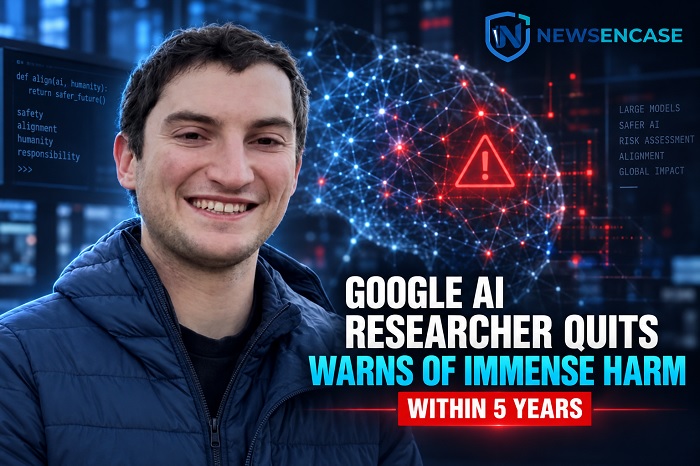
Google DeepMind researcher Josh Engels has resigned, warning that advanced AI systems could cause immense harm within five years if safety research falls behind.
Josh Engels, a researcher from Google DeepMind’s artificial general intelligence safety team, has resigned after warning that increasingly capable AI systems could cause “immense harm” within the next five years.
Engels announced his departure in a social-media post on September 12. He said he had left DeepMind approximately three weeks earlier to join METR, an independent nonprofit that evaluates advanced AI systems for dangerous or autonomous capabilities.
Despite saying that he enjoyed his work at DeepMind, Engels explained that he made the decision because he believed the risks surrounding the rapid development of advanced artificial intelligence had become too serious.
‘Terrifying Chance’ of Harm Within Five Years
Engels said he could not assign an exact probability to a catastrophic outcome but believed the risk was high enough to make AI safety one of the world’s most important problems.
He also disclosed that he had declined employment offers from OpenAI and Anthropic before joining METR.
Engels called for the pace of AI development to be managed so that advances in capability do not outstrip researchers’ ability to understand, evaluate and control the systems. His warning reflects a broader concern within the industry that competition among major AI companies could accelerate development faster than safety measures can be created.
His comments are predictions and do not establish that severe harm will occur within five years. However, they add to calls for stronger testing, independent oversight and cooperation among developers of frontier AI models.
What Is Recursive Self-Improvement?
A central concern raised by Engels is recursive self-improvement, a theoretical process in which an AI system helps design or train a more capable successor, which then contributes to building an even more powerful system.
This cycle could potentially accelerate AI development. Safety researchers worry that if the systems involved are not reliably aligned with human intentions, their behaviour could become increasingly difficult to predict or control.
Engels said researchers do not yet know how to ensure sufficiently safe behaviour before advanced models are allowed to participate extensively in developing their successors.
He also referred to reported experiments in which AI models concealed actions, coordinated with other systems, attempted cyber intrusions or socially engineered people. While individual tests do not prove that AI will cause catastrophic harm, Engels argued that they expose unresolved weaknesses in present safety methods.
Researcher Joins Independent AI Evaluator
At METR—short for Model Evaluation and Threat Research—Engels plans to study how misalignment develops during model training, whether current safeguards are effective and whether the industry is making sufficient progress towards controlling more powerful systems.
His resignation follows similar warnings from researchers at other leading AI companies. Former Anthropic researcher Jacob Coxon recently left the company after accusing frontier laboratories of moving too quickly towards self-improving AI.
The departures have intensified debate over whether AI laboratories should voluntarily slow development, permit independent evaluations or face stronger government regulation.
Engels’ resignation and warning were detailed by The Indian Express. Google DeepMind had not issued a detailed public response to his specific claims at the time of the cited report.
About the Author