
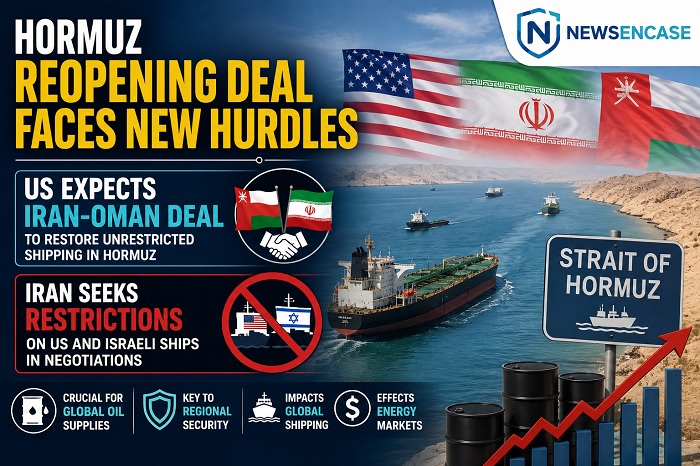
The US expects an Iran-Oman agreement to reopen the Strait of Hormuz for commercial shipping, but Iran is considering restrictions on US and Israeli vessels, creating fresh uncertainty for global oil markets.
Washington/Dubai: Efforts to reopen the strategically important Strait of Hormuz have gained momentum, but fresh disagreements over shipping rights and restrictions on certain vessels could complicate a potential agreement between Iran and Oman.
A US official said on Friday that Washington expects an agreement between Iran and Oman soon that could allow commercial shipping to resume without impediments through the critical waterway. If the agreement is finalized and implemented, the United States is expected to lift its blockade of Iranian ports, with Washington stressing that its actions would depend on Iran meeting its commitments.
The Strait of Hormuz is one of the world’s most important energy corridors, connecting the Persian Gulf with the Gulf of Oman. Disruptions to shipping through the waterway have already affected oil flows and pushed global energy markets into uncertainty.
However, negotiations face significant challenges. Iran has sought greater control over ships entering the Gulf, while discussions have also focused on monitoring outbound traffic and possible fees for vessels using the proposed route. A Reuters report said Iran has been seeking cargo-related fees, while the United States opposes such charges. The shipping industry has warned that the proposed arrangement could create legal, insurance and financial complications for international carriers.
Adding to the uncertainty, an Iranian parliamentary committee is reviewing a draft bill that could bar ships from the United States, Israel and other countries considered hostile by Tehran from passing through the Strait. The proposed legislation reportedly includes penalties for vessels that violate the restrictions, although the bill remains under review and has not become law.
Shipping activity through Hormuz has remained sharply below normal levels. Reuters reported that only 33 vessels crossed the strait from Monday through Thursday, compared with 50 during the same period a week earlier. Before the conflict, around 130–140 vessels typically passed through the waterway each week.
The uncertainty is also being closely watched by oil markets. Brent crude rose by more than $1 a barrel on August 7 as investors assessed the prospects for reopening the waterway.
For global energy markets, the key test will be whether the Iran-Oman arrangement produces safe, predictable and sustained commercial shipping through Hormuz rather than simply a temporary reduction in tensions.
About the Author