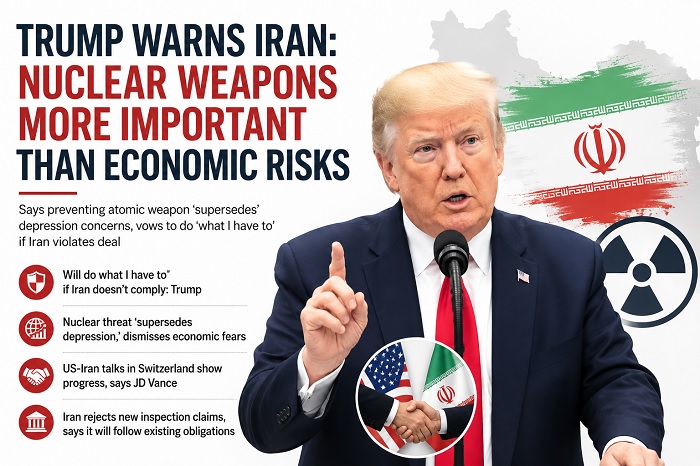
Washington: US President Donald Trump has issued a fresh warning to Iran, stating that preventing Tehran from acquiring nuclear weapons remains a top priority for the United States, even if it comes with economic consequences.
Speaking at the White House during the signing of executive orders related to quantum technology, Trump said Washington would take necessary action if Iran failed to honor any future nuclear agreement.
“If Iran doesn’t live up to their agreement, or if they’re not behaving, I will do what I have to do,” Trump told reporters, emphasizing that continued cooperation from Tehran would be essential for maintaining regional stability.
Nuclear Threat More Serious Than Economic Fallout
Dismissing concerns that military action against Iran could trigger a global economic downturn, Trump argued that the dangers posed by nuclear weapons far outweigh fears of recession or depression.
“Nuclear weapons supersede depression,” Trump said, adding that while economic crises are serious, the consequences of a nuclear-armed Iran would be far more severe.
The US President reiterated that military options remain on the table if diplomatic efforts fail to prevent Iran from advancing its nuclear program.
Trump Downplays Economic Costs of Potential Action
Trump’s remarks follow earlier comments in which he indicated that economic considerations would not deter the United States from addressing Iran’s nuclear ambitions.
During a recent public appearance, Trump suggested that securing control over Iran’s oil resources would be beneficial if circumstances allowed, although he acknowledged that such a move might not receive public support in the United States.
He also maintained that Republican voters broadly support his approach to Iran while expressing a desire to see American troops return home from overseas conflicts.
US Claims Progress in Switzerland Talks
The latest comments come amid ongoing diplomatic negotiations between Washington and Tehran following talks held in Switzerland under a 14-point memorandum of understanding (MoU).
Trump backed Vice President JD Vance’s assertion that Iran was willing to accept extensive weapons inspections as part of efforts to ensure transparency regarding its nuclear activities.
In a post on Truth Social, Trump stated that Iran would agree to major inspections designed to guarantee what he described as “nuclear honesty” in the future.
Vice President Vance described the Switzerland negotiations as productive and said both sides had established a strong foundation for a potential final agreement.
“We laid a very good foundation for a successful final deal,” Vance said, adding that enhanced inspections could help ensure Iran does not develop nuclear weapons.
Iran Rejects New Inspection Claims
Iran has pushed back against the US characterization of the talks. Iranian Foreign Ministry spokesperson Esmaeil Baqaei said Tehran had not agreed to any new inspection framework beyond its existing commitments.
According to Baqaei, Iran’s cooperation with the International Atomic Energy Agency (IAEA) will continue under current safeguards agreements and in accordance with decisions made by Iran’s Parliament and Supreme National Security Council.
The differing accounts from Washington and Tehran highlight the challenges that remain as both sides continue negotiations aimed at resolving long-standing disputes over Iran’s nuclear program.
As diplomatic efforts continue, uncertainty remains over whether the two countries can reach a comprehensive agreement that satisfies international concerns while addressing Iran’s demands.
About the Author