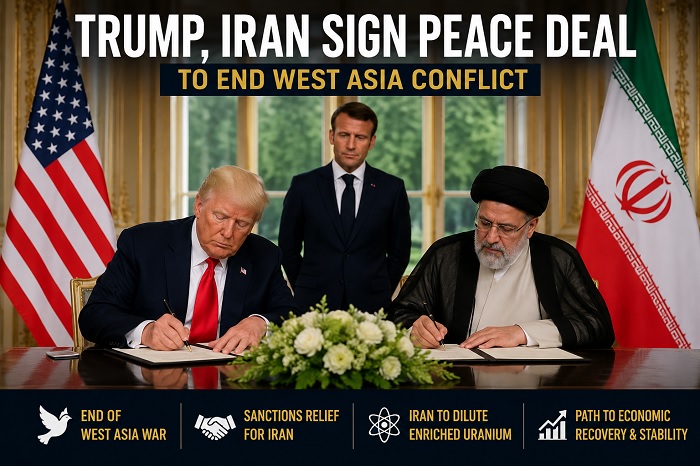
Washington/Versailles: U.S. President Donald Trump and Iranian President signed a landmark agreement on June 17, 2026, aimed at ending the prolonged West Asia conflict. Under the deal, Iran has agreed to dilute its enriched uranium stockpile in exchange for significant economic relief and sanctions rollback from the United States.
The memorandum of understanding was signed by President Trump during a dinner with French President Emmanuel Macron at the Palace of Versailles following the G7 Summit. Iranian Foreign Ministry spokesperson Esmaeil Baqaei confirmed that the agreement had been finalized with the signatures of both presidents.
The conflict, which began on February 28 following military action by the United States and Israel against Iran, escalated into a regional crisis involving missile and drone attacks and the closure of the Strait of Hormuz, a critical global energy route.
As part of the agreement, Washington will immediately lift key oil sanctions that have severely impacted Iran’s economy. The United States has also pledged to facilitate a proposed $300 billion reconstruction and financing package backed by regional countries once a final nuclear agreement is reached.
Iranian officials described the agreement as a strategic victory, while some U.S. lawmakers criticized the move. Republican Senator Bill Cassidy argued that the deal failed to adequately curb Iran’s nuclear ambitions and rewarded Tehran without securing lasting guarantees.
The agreement marks the beginning of a two-month negotiation period focused on developing a comprehensive framework for Iran’s nuclear program. According to the released text, Iran will dilute its enriched uranium under the supervision of the International Atomic Energy Agency (IAEA), paving the way for broader economic assistance and regional stabilization efforts.
The reopening of the Strait of Hormuz is expected to be one of the first outcomes of the agreement, potentially easing global energy market concerns. Oil prices remained volatile on Wednesday as investors reacted to uncertainty surrounding the signing before stabilizing later in the day.
Meanwhile, tensions continue in Lebanon despite the broader peace initiative. Israeli military operations and rocket attacks were reported in southern Lebanon, highlighting the challenges that remain in securing lasting regional stability.
The deal is widely seen as a crucial first step toward ending months of conflict, although its long-term success will depend on implementation and future negotiations over Iran’s nuclear activities.
About the Author