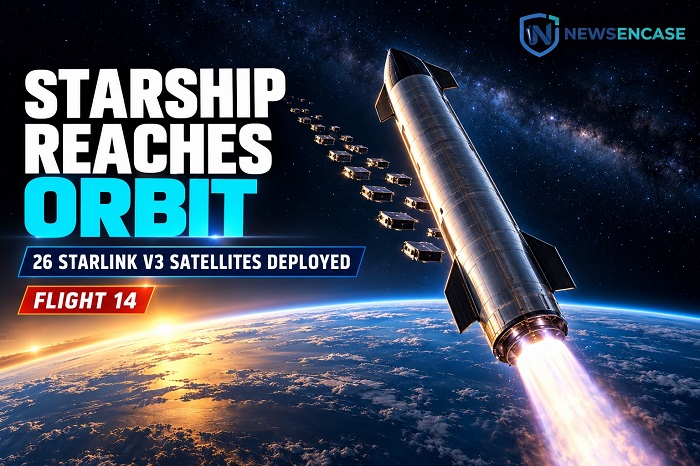
SpaceX’s Starship reached Earth orbit for the first time and deployed 26 Starlink V3 satellites before returning after a shortened three-hour mission.
SpaceX’s Starship has successfully reached Earth orbit for the first time during its 14th flight test, marking a major milestone for the world’s most powerful rocket system.
The uncrewed spacecraft deployed 26 next-generation Starlink V3 satellites before returning to Earth after approximately three hours—much earlier than the nearly 10-hour mission originally planned.
Despite engine problems during the flight, SpaceX completed the mission’s most important objectives, including orbital insertion, satellite deployment and controlled splashdowns of both the Super Heavy booster and Starship upper stage.
Starship Completes First Orbital Flight
Starship Flight 14 lifted off from SpaceX’s Starbase facility in Texas at 12:48 UTC on September 28, 2026.
The launch vehicle consists of the Super Heavy first-stage booster and the Starship upper-stage spacecraft. Previous Starship tests had entered space but followed suborbital trajectories without completing a stable Earth orbit.
During Flight 14, one of the booster’s 33 engines shut down shortly after liftoff. However, the remaining engines successfully carried the vehicle through the first phase of ascent.
After separating from Starship, the Super Heavy booster performed its return manoeuvres and completed a controlled splashdown in the Gulf of Mexico. SpaceX did not attempt to catch the booster using the launch tower’s mechanical arms.
Engine Shuts Down Early During Ascent
One of Starship’s three vacuum-optimised Raptor engines stopped firing earlier than planned as the upper stage continued towards orbit.
SpaceX initially indicated that the spacecraft might remain on a suborbital trajectory. Engineers later determined that Starship could safely perform its orbital-insertion burn, and the company proceeded with the manoeuvre.
“Starship is in orbit,” SpaceX announced during its live broadcast after confirming the successful burn.
The mission demonstrated that Starship could compensate for an engine problem and still reach orbit with its payload.
26 Starlink V3 Satellites Deployed
After reaching an altitude of approximately 269 kilometres, Starship opened its payload bay and began deploying 26 operational Starlink V3 satellites.
All the satellites were released within approximately 30 minutes, and contact was subsequently established with each spacecraft.
The V3 satellites are larger and more capable than earlier Starlink models. SpaceX says each satellite can add around one terabit per second of capacity to the network.
The deployment represented Starship’s first delivery of an operational payload into stable Earth orbit. It also demonstrated the rocket’s potential to carry large numbers of next-generation satellites on future missions.
Why Starship Returned After Three Hours
The original mission plan called for Starship to complete approximately six orbits during a flight lasting nearly 10 hours. The spacecraft was then expected to re-enter the atmosphere and splash down in the South Pacific west of Chile.
SpaceX instead chose an early-return contingency after the vacuum-engine shutdown. Starship completed its deorbit manoeuvre and returned after three hours, eight minutes and 27 seconds.
The spacecraft made a controlled re-entry and splashed down upright in a predetermined area of the North Pacific. It later tipped over and exploded as residual propellant was released. No people or property were at risk.
SpaceX had prepared both the original and contingency splashdown zones before the flight, allowing the company to end the mission safely.
Major Step Towards a Reusable Rocket
Starship is central to SpaceX’s plans to deploy upgraded Starlink satellites, transport cargo and eventually carry people to the Moon and Mars.
NASA is also depending on a modified Starship spacecraft to serve as a lunar landing system for future Artemis missions. However, SpaceX must still demonstrate orbital refuelling and the rapid recovery and reuse of both rocket stages.
Flight 14 did not complete its full 10-hour mission, but reaching orbit and deploying all 26 satellites represented a significant advance for the programme.
SpaceX is expected to analyse the premature engine shutdown and data collected during re-entry before proceeding with Starship’s 15th flight test.
About the Author