
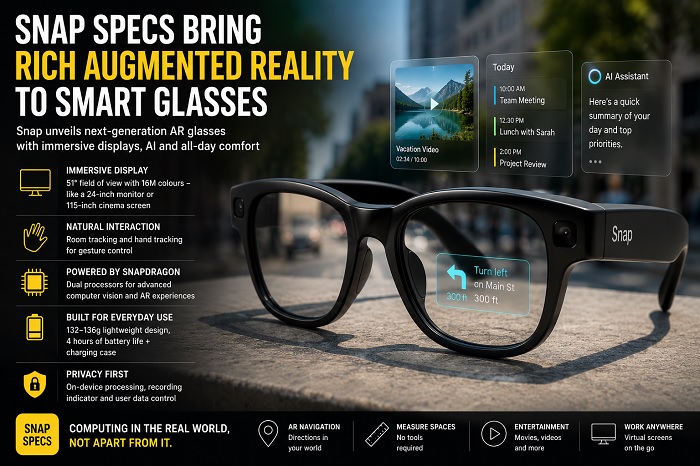
California: Tech company Snap has unveiled its next-generation augmented reality (AR) smart glasses, called Specs, combining immersive mixed-reality experiences with the portability and convenience of AI-powered eyewear.
The new device was introduced at the Augmented World Expo (AWE) in Long Beach, California, marking Snap’s biggest step yet into the wearable computing market. Designed to deliver entertainment, productivity tools and AI assistance directly within a user’s field of view, Specs aim to bridge the gap between bulky mixed-reality headsets and lightweight smart glasses.
Unlike many AI glasses currently on the market, Snap is prioritising rich augmented reality experiences. The glasses feature a high-resolution display capable of showing 16 million colours and offer a 51-degree field of view. According to Snap, the experience is comparable to using a 24-inch desktop monitor for work or watching content on a 115-inch home cinema screen positioned several metres away.
Specs also include room-tracking technology and hand-gesture controls, allowing virtual objects to remain anchored in the real world. Users can navigate applications and interact with digital content without needing physical controllers.
Weighing between 132 and 136 grams, the glasses are heavier than standard AI eyewear but significantly lighter than mixed-reality headsets. The device operates independently without requiring an external computing unit, making it more practical for everyday use.
Snap showcased several use cases, including real-time navigation with directions projected onto streets, measuring spaces digitally, watching movies and creating virtual workstations. Hundreds of AR applications, known as “Lenses,” have already been developed by creators using earlier developer versions of the platform.
The company said augmented reality offers far greater possibilities than simply displaying existing apps in front of a user’s eyes, envisioning future applications in education, creativity, entertainment and workplace productivity.
Built using Swiss thermoplastic polymer TR90, which Snap co-founder Evan Spiegel described as “plastic titanium,” the glasses are designed for long-term comfort. They also support prescription lenses through removable inserts and feature electrochromic lenses that automatically darken in bright sunlight.
Battery life extends up to four hours of mixed use, while the accompanying charging case provides four additional recharges throughout the day.
Under the hood, Specs use liquid crystal on silicon (LCoS) display technology and advanced waveguides to project images directly into the wearer’s eyes. Two Qualcomm Snapdragon processors power computer vision capabilities and AR applications.
Snap emphasized privacy protections, including an LED recording indicator and user controls over data storage and sharing. Most processing takes place directly on the device, while AI-powered interactions are handled through cloud computing services.
The launch represents the culmination of more than a decade of development by Snap, which first entered the smart glasses market in 2016. The company plans to begin shipping Specs in autumn 2026.
The announcement also increases competition in the emerging AR wearables market, where companies such as Meta, Google, Samsung and Apple are investing heavily in next-generation smart glasses and mixed-reality devices.
About the Author


