
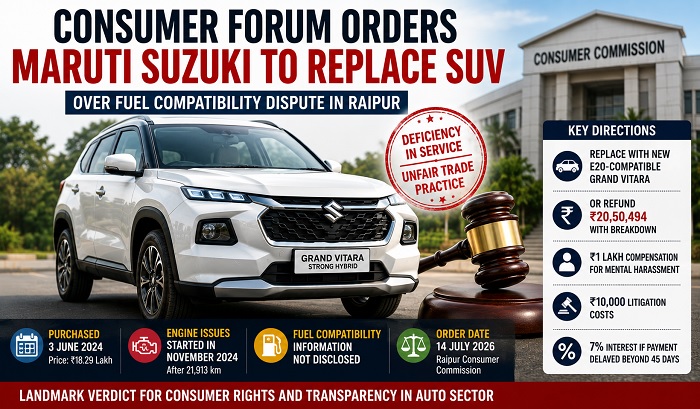
The Raipur Consumer Commission has directed Maruti Suzuki to replace a Grand Vitara Strong Hybrid with an E20-compatible model, holding the automaker and dealer guilty of unfair trade practices and deficiency in service.
Raipur: In a landmark ruling that could have far-reaching implications for India’s automobile industry, the Raipur District Consumer Disputes Redressal Commission (Additional Bench) has directed Maruti Suzuki India Ltd. and its dealer to replace a customer’s Grand Vitara Strong Hybrid with a new E20-compatible model. The Commission held both the manufacturer and dealer guilty of deficiency in service and unfair trade practices.
The order, delivered on July 14, 2026, comes amid growing discussions over the use of E20 (20% ethanol-blended) petrol, which is being promoted by the Indian government as a cleaner alternative fuel.
How the Dispute Began
The case was filed by Dr. Premraj Devta, a 41-year-old nephrologist from Raipur, who purchased a Maruti Suzuki Grand Vitara Strong Hybrid Zeta Plus for ₹18.29 lakh on June 3, 2024.
According to the complaint, neither the company nor the dealer informed him that the vehicle was not fully compatible with E20 fuel, despite the fuel becoming increasingly available across India. The customer later discovered that the vehicle sold as new had actually been manufactured in January 2023, nearly 17 months before its sale.
The SUV reportedly ran without issues for around 21,913 km before displaying an engine malfunction warning in November 2024. Despite multiple visits to the dealership, repeated fuel tank cleaning, and replacement of several components, the problem persisted. The customer then approached the Consumer Commission seeking relief.
Maruti Suzuki and Dealer’s Defence
Maruti Suzuki and the dealership denied any manufacturing defect, arguing that the engine issues were caused by the use of contaminated or poor-quality fuel. The company submitted laboratory test reports claiming that the fuel sample taken from the vehicle did not meet quality standards and asserted that such damage was not covered under the vehicle’s warranty.
Why the Consumer Commission Ruled Against the Company
The Commission rejected the company’s defence, observing that the vehicle manufactured in January 2023 was not designed for E20 fuel compatibility. It held that the manufacturer and dealer failed to disclose this crucial information to the buyer at the time of sale.
The Commission further noted that repeatedly cleaning the fuel tank could not resolve a compatibility-related issue and concluded that withholding such information amounted to deficiency in service and unfair trade practice.
Compensation and Directions
The Commission directed Maruti Suzuki and the dealer to comply with the following within 45 days:
- Replace the existing vehicle with a new E20-compatible Grand Vitara of the same model.
- If replacement is not possible, pay the customer ₹20,50,494, including:
- Vehicle price: ₹18,29,000
- RTO charges: ₹1,86,850
- Insurance premium: ₹34,644
- Pay ₹1 lakh as compensation for mental harassment.
- Pay ₹10,000 towards litigation costs.
- If the payment is delayed beyond 45 days, the amount will attract 7% annual interest from the date of the order until payment.
Industry Impact
The ruling is expected to influence the Indian automobile sector as manufacturers increasingly transition to E20-compatible vehicles under the government’s ethanol-blending programme. Legal experts believe the judgment reinforces the need for greater transparency regarding fuel compatibility, warranty terms, and vehicle specifications, while strengthening consumer rights in the evolving automotive market.
About the Author


