
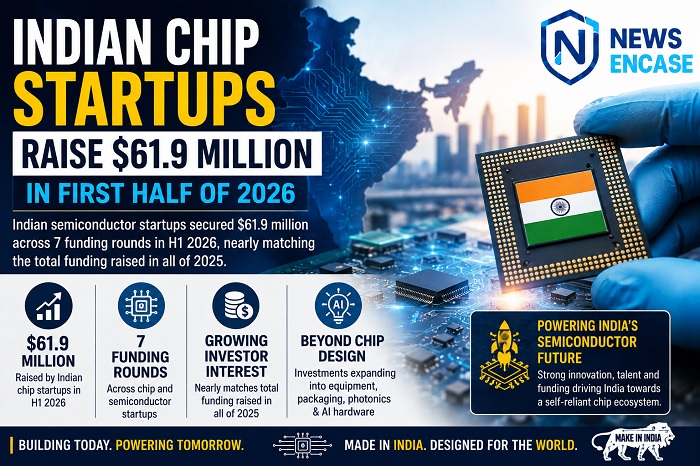
Indian semiconductor startups raised $61.9 million across seven funding rounds in H1 2026, with investors increasingly backing chip equipment, packaging, photonics and AI hardware.
New Delhi: India’s semiconductor startup ecosystem is showing stronger investor momentum, with domestic chip startups raising approximately $61.9 million across seven funding rounds during the first half of 2026. The funding nearly matched the amount raised by the sector during the whole of 2025, highlighting growing investor interest in India’s emerging semiconductor industry.
The latest funding trend comes as India intensifies efforts to develop a complete semiconductor ecosystem covering chip design, manufacturing, semiconductor equipment, assembly, testing, packaging and advanced electronics.
According to industry data, Indian semiconductor startups have raised around $206 million across 51 funding rounds since 2022. However, the number of funding deals has been falling even as the amount of capital deployed has increased. There were 16 funding rounds in 2024, 13 in 2025 and seven during the first half of 2026.
Investment Moves Beyond Chip Design
One of the most significant changes in India’s semiconductor startup landscape is the expansion of investment beyond traditional chip design.
Investors are increasingly looking at companies working on semiconductor manufacturing equipment, advanced packaging, photonics and AI-focused semiconductor technologies. This broader investment could help India build supporting industries around future chip fabrication facilities rather than depending primarily on overseas suppliers.
The development is particularly important because a successful semiconductor ecosystem requires much more than fabrication plants. Companies developing intellectual property, design tools, packaging technologies, testing equipment and specialised components are essential to creating a competitive supply chain.
Government Support Strengthens Ecosystem
Government policy is also playing a major role in attracting capital to the sector. India has been expanding support for semiconductor startups through initiatives designed to encourage domestic chip design and manufacturing.
Under the government’s semiconductor programmes, 103 fabless chip design companies have received support to access advanced chip-design infrastructure, while several supported designs have already moved toward fabrication. The government has also highlighted the development of semiconductor intellectual property and the creation of startups capable of scaling their products.
More recently, the proposed Semicon 2.0 strategy has indicated a shift toward milestone-based funding and potential government equity participation in semiconductor startups, alongside venture-capital investment. The approach is intended to provide companies with larger and more sustained financial support as they move from research and design toward commercialisation.
India’s Semiconductor Talent Base Expands
India already has a significant advantage in semiconductor engineering and research. The government says the country hosts around 7% of the world’s semiconductor-related Global Capability Centres and employs nearly 20% of the global semiconductor chip-design workforce.
A growing number of experienced semiconductor professionals are also leaving multinational companies to establish startups in India. Entrepreneurs with experience at companies such as Intel, Qualcomm and Texas Instruments are increasingly working on chip design, embedded systems and other semiconductor technologies.
Funding Signals a Broader Technology Shift
The semiconductor funding surge comes despite a more selective startup investment environment. India’s overall startup funding has increasingly become concentrated in larger deals, with investors placing greater emphasis on companies with strong technology, commercial potential and clearer growth strategies.
For semiconductor startups, this shift could favour businesses capable of moving from research and prototypes to commercial products and global markets.
The $61.9 million raised in just six months therefore represents more than a funding milestone. It signals growing confidence that Indian semiconductor companies can become important participants in the global chip supply chain.
As government incentives, private investment and engineering talent converge, India’s semiconductor startup ecosystem is gradually expanding from chip design into a broader technology and manufacturing ecosystem.
About the Author


