
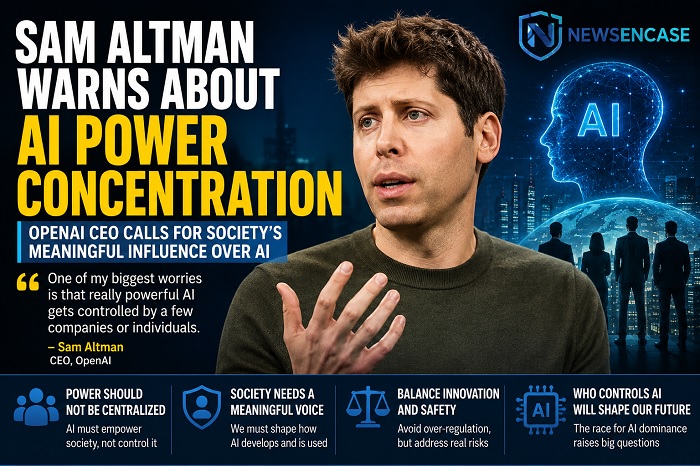
OpenAI CEO Sam Altman has raised fresh concerns about the concentration of artificial intelligence power, warning that increasingly capable AI systems could eventually be controlled by only a small number of companies or individuals.
Speaking on David Senra’s podcast, Altman argued that society must retain meaningful influence over how powerful AI systems are developed and deployed. He said one of his biggest concerns is a future in which a handful of organizations gain disproportionate control over technology capable of reshaping economies and everyday life.
Altman Pushes for Democratization of AI
Altman’s comments reflect his broader argument that advanced AI should ultimately distribute power rather than concentrate it.
He said society should remain involved in determining AI’s direction instead of leaving major decisions exclusively to technology companies. At the same time, Altman cautioned against responding to AI risks with restrictions so severe that individual freedom and technological innovation are unnecessarily sacrificed in the name of safety.
The debate has become increasingly important as companies including Microsoft, Amazon, Google, Meta and Nvidia invest enormous sums in AI models, chips and data centers. The immense computing resources required to build frontier systems have raised questions about whether only the world’s wealthiest companies will be able to compete at the highest level.
Open Models Become Part of the Debate
Another key issue is whether powerful AI models should be open or proprietary.
Altman pointed to China’s growing use of open-weight AI models, which can give developers broader access to model parameters and encourage experimentation. US AI companies have generally taken different approaches to openness, particularly as concerns grow about cybersecurity and misuse.
OpenAI has released some open-weight models while keeping its most advanced technology proprietary, illustrating the difficult balance between wider access and safety.
AI Safety Concerns Are Also Growing
Altman’s comments arrive during a broader debate in Washington over how rapidly advancing AI should be governed. US lawmakers have recently pressed leading AI companies for more information about safety controls surrounding highly autonomous AI agents, adding political pressure for stronger oversight of frontier systems.
The central challenge is increasingly becoming not simply how powerful AI will become, but who gets to control that power.
As AI capabilities advance, Altman’s latest warning reinforces a growing debate across the technology industry: whether artificial intelligence will empower millions of individuals and businesses or ultimately concentrate unprecedented technological and economic influence among a relatively small group of organizations.
About the Author