
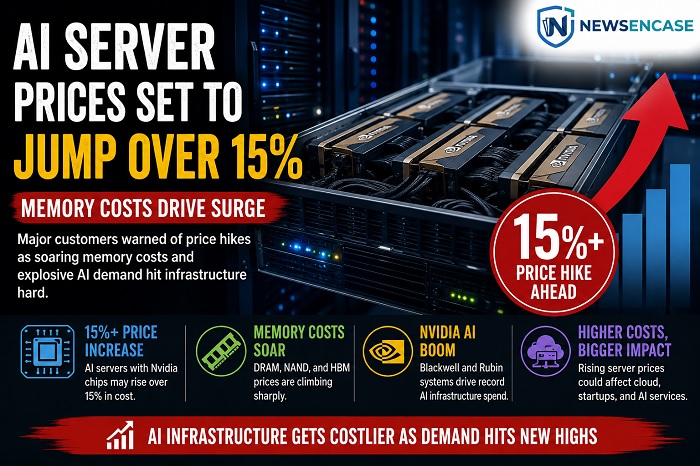
The cost of building artificial-intelligence infrastructure could climb even higher, with prices for some AI servers containing Nvidia chips expected to rise by more than 15% as soaring memory costs put fresh pressure on the global data-centre industry.
Major customers have been notified about the potential increases, according to a Bloomberg News report cited by Reuters. The development comes as unprecedented demand for AI computing continues to strain supplies of critical components used in high-performance servers.
AI Server Prices Could Rise More Than 15%
AI servers are significantly more complex and expensive than conventional enterprise systems, combining high-end GPUs with large quantities of advanced memory, networking equipment and other specialized components.
Memory has emerged as one of the biggest cost pressures. Prices for DRAM and NAND flash memory have risen sharply, while high-bandwidth memory (HBM)—a crucial component for modern AI accelerators—remains in exceptionally strong demand.
As suppliers pass those increased component costs through the supply chain, customers purchasing Nvidia-powered AI servers could see prices increase by more than 15% in some cases.
Nvidia’s AI Chips Drive Massive Infrastructure Boom
Nvidia remains at the centre of the global AI infrastructure expansion.
Technology giants, cloud providers, governments and AI startups are spending billions of dollars building data centres capable of training and running increasingly sophisticated artificial-intelligence models.
Demand has expanded from Nvidia’s Hopper generation to its newer Blackwell systems, while customers are also preparing for the company’s next-generation Rubin architecture.
That expansion means demand is rising not only for GPUs but also for the memory, storage, networking and power infrastructure surrounding them.
Memory Shortage Adds to AI Costs
The AI boom has transformed the global memory market.
Advanced AI accelerators require enormous amounts of HBM, while AI servers also consume substantially more conventional DRAM than ordinary servers. Memory manufacturers have therefore shifted production capacity toward higher-margin products designed for AI systems.
That transition can tighten supplies elsewhere in the market and push prices upward.
For companies planning large AI deployments, a double-digit increase in server prices could translate into millions—or potentially billions—of dollars in additional infrastructure spending, depending on the scale of their data-centre projects.
AI Spending Already Reaching Record Levels
The potential price increases arrive as the world’s biggest technology companies continue committing extraordinary sums to AI infrastructure.
Microsoft, Meta, Amazon and Google parent Alphabet are among the companies investing heavily in AI data centres, accelerators, networking and power capacity.
Higher server costs could therefore increase the already enormous capital requirements associated with competing at the frontier of artificial intelligence.
Nvidia Earnings Put AI Spending in Spotlight
The development is particularly timely because investors are awaiting Nvidia’s fiscal second-quarter earnings on August 26, which are expected to provide another major indicator of the strength of global AI demand.
Markets will be watching Nvidia’s results and outlook for evidence that customers remain willing to sustain aggressive infrastructure spending despite rising costs.
The central question is increasingly shifting from whether companies want more AI computing capacity to how much they are prepared to pay for it.
If AI server prices rise by more than 15%, the consequences could extend beyond Nvidia’s largest customers. Higher infrastructure costs could eventually affect cloud-computing prices, AI startups and the cost of developing and operating generative-AI services.
For now, however, demand for advanced AI infrastructure remains exceptionally strong—giving hardware and component suppliers greater ability to pass rising costs on to customers.
About the Author


