
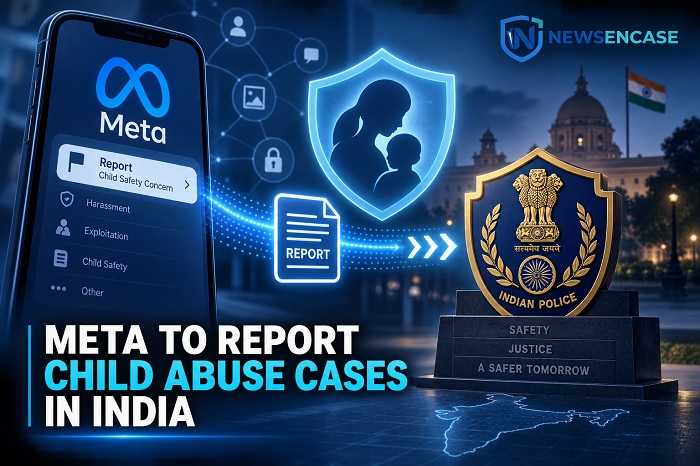
Meta has agreed to report child sexual abuse and child-safety cases directly to Indian law-enforcement agencies amid increased government scrutiny.
Meta has agreed to report cases involving child sexual abuse and other child-safety concerns directly to appropriate law-enforcement agencies in India, marking a significant change in how the company handles such incidents on Facebook and Instagram.
Government sources confirmed the development on September 15, describing it as an initial step towards improving online safety for children. The authorities involved in receiving the reports have not yet been publicly identified.
Previously, Meta primarily submitted reports concerning child sexual abuse material, or CSAM, to the US-based National Center for Missing & Exploited Children. The organisation would then coordinate with authorities in other countries. Under the new arrangement, relevant cases will also be routed to Indian agencies, according to ThePrint.
Government Calls Child Safety ‘Non-Negotiable’
Indian officials said protecting children online was a fundamental responsibility of every social-media platform operating in the country.
The government is also holding discussions with other online platforms, asking them to proactively detect and remove CSAM and other harmful content. Officials warned that action could be taken against companies that fail to introduce adequate child-protection measures.
Meta’s decision follows several weeks of discussions with the Centre. The company’s global and Indian executives reportedly held meetings with government officials beginning on August 5.
Government representatives had sought information about Meta’s algorithms, content-moderation processes, compliance mechanisms and safeguards against CSAM and deepfake content.
Meta Faced Scrutiny Over Harmful Advertisements
In July, the Ministry of Electronics and Information Technology summoned Meta executives following reports that Instagram had carried paid advertisements associated with child sexual abuse imagery.
An investigation cited by ThePrint identified 332 advertisements containing AI-generated abusive imagery over approximately 10 months. Of these, 84 were reportedly shown in India.
The National Commission for Protection of Child Rights took suo motu cognisance of the allegations and issued a notice to Meta. After examining the company’s response, the commission summoned Meta India representatives to appear before it on September 9.
Separately, the National Human Rights Commission asked Delhi Police to investigate the allegations and examine whether reporting requirements under the Protection of Children from Sexual Offences Act had been followed.
Questions Over Platform Accountability
The government has also reportedly raised questions about whether Meta remains eligible for safe-harbour protection under Section 79 of the Information Technology Act. The provision offers conditional protection to online intermediaries against liability for content posted by users.
Meta’s agreement could help Indian investigators receive information more quickly, reducing their dependence on an overseas reporting channel. However, details about reporting timelines, data-sharing procedures and the agencies responsible for receiving and investigating cases remain unclear.
Officials have characterised the agreement as only a first step, stressing that platforms must also strengthen detection systems, promptly remove illegal content and prevent abusive material from being distributed.
About the Author