
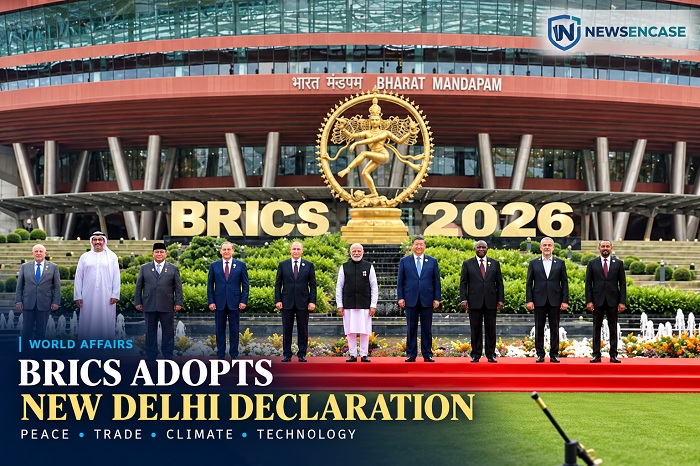
New Delhi: The 18th BRICS Leaders’ Summit concluded in New Delhi with member countries adopting the New Delhi Declaration and pledging greater cooperation on international conflicts, trade, technology, climate change, health and reform of global institutions.
Prime Minister Narendra Modi, addressing the summit at Bharat Mandapam, warned that geopolitical tensions, supply-chain disruptions, pandemics and climate-related disasters were increasingly affecting ordinary people across national borders. He also raised concerns over the “weaponisation” of technology and critical minerals, calling for stronger cooperation among developing economies.
BRICS Calls for Restraint in Middle East
The declaration expressed deep concern over escalating violence in the Middle East and urged all sides to exercise maximum restraint. The leaders supported resolving international disputes through dialogue, consultation and diplomacy.
Securing a unanimous declaration was considered significant because the expanded BRICS grouping includes Iran and the United Arab Emirates, which hold sharply different positions on the current regional conflict.
The summit also discussed conflicts in Sudan and other regions, growing nuclear risks and the rise in global military expenditure. Members reaffirmed their support for preventive diplomacy and peaceful conflict resolution.
Terrorism and Pahalgam Attack
BRICS leaders condemned terrorism in all its forms and reportedly referred specifically to the April 2025 Pahalgam attack, which killed 26 people. The declaration rejected double standards in counterterrorism and called for action against terrorist financing and safe havens.
Global Governance and Trade Reform
The bloc supported comprehensive reform of the United Nations, including the Security Council, to increase representation for developing countries from Asia, Africa and Latin America.
UN Secretary-General Antonio Guterres backed the call for international institutions to reflect contemporary geopolitical and economic realities instead of the global order created after World War II.
BRICS also criticised unilateral sanctions, tariff barriers and other protectionist measures that disrupt international trade and supply chains. Members supported expanding trade in local currencies and strengthening cross-border payment systems.
Health, AI and Climate Cooperation
The summit backed closer collaboration in artificial intelligence, digital infrastructure, food security, energy, critical minerals and climate action. Prime Minister Modi announced an integrated BRICS early-warning system for infectious diseases to improve preparations for future outbreaks.
The declaration additionally supported a fair and inclusive energy transition while acknowledging that fossil fuels would continue to play an important role in emerging economies.
India presented BRICS as a platform for practical cooperation rather than an alliance directed against any country. At the conclusion of the summit, the grouping’s chairship was passed to China for the next term.
About the Author