
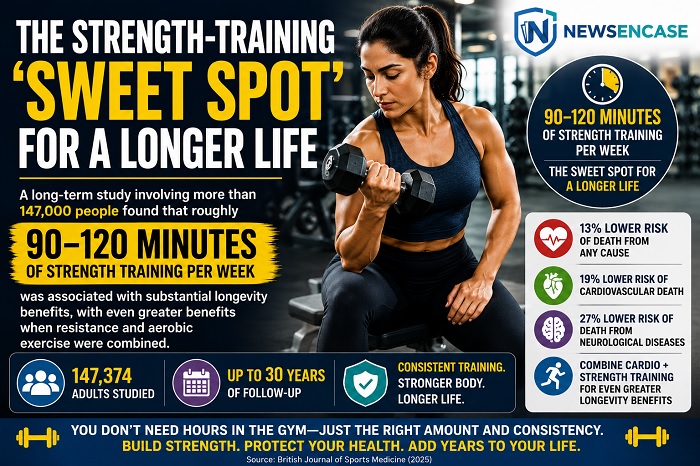
You may not need to spend hours lifting weights every day to gain meaningful long-term health benefits. A major study suggests that roughly 90 to 120 minutes of strength training per week may represent a “sweet spot” associated with a lower risk of premature death.
The research, published in the British Journal of Sports Medicine, analyzed 147,374 adults from three long-running US cohorts and followed participants for up to 30 years. During the follow-up period, researchers documented 35,798 deaths and examined how long-term resistance-training habits related to mortality.
90–119 Minutes Linked to 13% Lower Overall Death Risk
Compared with people who reported no resistance training, participants completing 90–119 minutes per week had a 13% lower risk of death from any cause, after researchers adjusted for aerobic activity and other factors.
The same amount was associated with a 19% lower risk of cardiovascular death and a 27% lower risk of death from neurological diseases.
Importantly, these findings describe associations rather than proving that strength training itself caused participants to live longer.
More Than Two Hours Wasn’t Necessarily Better
One of the study’s most interesting findings was that the longevity association appeared to plateau at around two hours of resistance training per week.
Researchers found no additional reduction in mortality risk above approximately 120 minutes per week.
That doesn’t mean exercising for longer is harmful or that everyone should stop at exactly two hours. Instead, it suggests people may be able to capture substantial longevity benefits without spending enormous amounts of time lifting weights.
Cardio Plus Strength Produced Stronger Results
Resistance training wasn’t the entire story.
Researchers found some of the lowest mortality risks among people who combined regular aerobic activity with resistance training. For example, participants completing 60–119 minutes of resistance training alongside relatively high levels of aerobic activity had substantially lower mortality risk than people doing inadequate aerobic activity and no resistance training.
Activities such as brisk walking, running, cycling and swimming can provide the aerobic component, while weights, resistance bands and bodyweight exercises can strengthen muscles.
Why Strength Training Matters as We Age
Muscle mass and strength naturally tend to decline with age. Resistance exercise can help maintain muscle, strength, mobility and physical independence while also supporting bone and metabolic health.
That makes strength training increasingly important not simply for building a muscular physique, but as part of a broader healthy-aging strategy.
The latest findings complement current recommendations encouraging adults to combine aerobic activity with muscle-strengthening exercise rather than relying exclusively on one type of workout.
The Longevity Takeaway
The study does not establish a universal prescription of exactly 90–120 minutes, and individual exercise needs vary with age, fitness and health status.
But its message is encouraging: you don’t necessarily need endless gym sessions to gain meaningful benefits from strength training.
For long-term health, a sustainable routine combining roughly one-and-a-half to two hours of weekly resistance exercise with regular cardio may offer a powerful combination—and consistency over years is likely more important than chasing a perfect workout.
About the Author


