
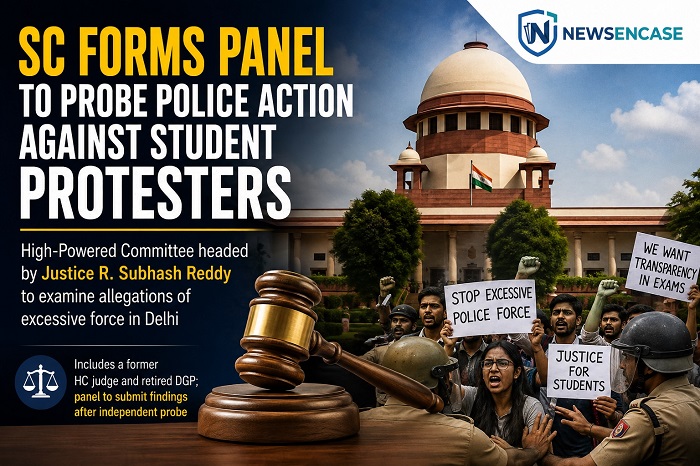
New Delhi: The Supreme Court has constituted a high-powered committee to examine allegations of excessive use of force and violence by police and other authorities against student protesters during demonstrations linked to the NEET examination controversy. The panel will be headed by former Supreme Court judge Justice R. Subhash Reddy.
The development comes amid petitions before the apex court alleging that students protesting against alleged NEET paper leaks and demanding reforms in the examination system were subjected to excessive police action in Delhi and other parts of the country.
The Supreme Court had earlier indicated that an independent committee would be formed to investigate the allegations. On August 1, a bench headed by Chief Justice of India Surya Kant, along with Justices Joymalya Bagchi and V. Mohana, discussed the proposed panel and its composition.
The committee is expected to include a former High Court judge and a retired Director General of Police. The court had also informed the parties that the consent of a former CBI Director and a former DGP, neither belonging to any of the states connected with the matter, had been obtained.
The move follows a series of student protests at Jantar Mantar and other locations over alleged irregularities in the NEET examination process. Demonstrators have demanded greater transparency in competitive examinations, accountability over alleged paper leaks and wider reforms to prevent future disruptions.
On July 20, thousands of students reportedly took part in a march towards Parliament in central Delhi. The protesters raised several demands, including calls for the resignation of Union Education Minister Dharmendra Pradhan and reforms in the examination system.
As the protesters attempted to move towards Parliament and cross police barricades, security personnel used tear gas and lathi-charge to disperse the crowd. Videos that subsequently circulated on social media appeared to show clashes between police personnel and protesters, prompting allegations of excessive force.
The Delhi Police has defended its actions, maintaining that force was used only after sections of the crowd allegedly became violent and resorted to stone-pelting. The competing claims have intensified calls for an impartial examination of what happened during the demonstrations.
The Supreme Court-appointed high-powered committee is now expected to examine the circumstances surrounding the protests, the conduct of the police and other agencies, and the allegations made by the protesting students. Its findings could provide important clarity on whether established procedures were followed while handling the demonstrations.
The committee’s formation also underscores the Supreme Court’s effort to independently assess allegations involving police conduct during large-scale student protests. Further details regarding the panel’s functioning, scope of inquiry and timeline are expected to emerge as the proceedings progress.
About the Author


