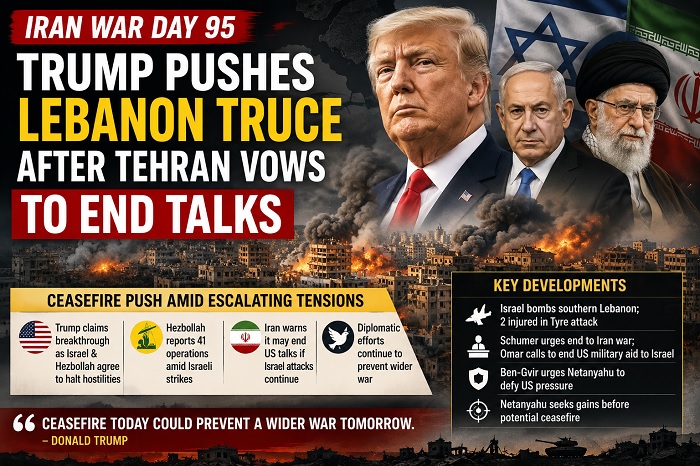
Washington/Beirut/Tehran: Efforts to prevent a wider Middle East conflict intensified on Day 95 of the Iran-Israel war, as U.S. President Donald Trump announced a breakthrough ceasefire understanding between Israel and Hezbollah, while Iran warned it could suspend negotiations with Washington if Israeli military operations in Lebanon continue.
The diplomatic push comes amid escalating tensions in southern Lebanon and growing concerns that renewed fighting could derail broader regional negotiations involving Iran and the United States.
Trump Claims Progress in Israel-Hezbollah Ceasefire Efforts
President Trump said he secured commitments from both Israel and Hezbollah to halt hostilities following discussions with Israeli Prime Minister Benjamin Netanyahu and intermediaries linked to Hezbollah.
The U.S. president described the development as a major diplomatic achievement aimed at preventing a larger Israeli offensive toward Beirut and preserving ongoing regional negotiations.
However, uncertainty remains over the durability of any ceasefire agreement, with both sides continuing military operations and issuing conflicting statements.
Netanyahu Maintains Pressure on Hezbollah
Despite Trump’s announcement, Netanyahu’s office stated that Israeli strikes on Beirut’s southern suburbs would proceed if Hezbollah continued launching attacks on Israeli cities.
Israeli authorities also confirmed that military operations in southern Lebanon would continue as planned, signaling that Israel remains prepared for further escalation if attacks persist.
Israeli National Security Minister Itamar Ben-Gvir publicly criticized international pressure to halt operations, urging the government to continue military action against Hezbollah.
Iran Warns Ceasefire Violations Could Impact Nuclear Talks
Iranian Foreign Minister Abbas Araghchi said the ceasefire framework negotiated between Tehran and Washington extends across the region, including Lebanon.
He warned that violations by Israel or Hezbollah could undermine broader diplomatic efforts and carry consequences for both the United States and Israel.
Adding to the pressure, Iran’s chief negotiator Mohammad Bagher Ghalibaf stated that Tehran may suspend negotiations with Washington if Israeli military operations in Lebanon continue.
Fighting Continues Across Southern Lebanon
Despite diplomatic efforts, violence continued overnight across southern Lebanon.
Israeli airstrikes reportedly targeted multiple locations, including areas near Tyre, where rescue teams pulled injured civilians from damaged buildings.
Hezbollah claimed responsibility for 41 military operations on Monday, including rocket attacks, drone strikes, ambushes, and assaults targeting Israeli troop positions and military infrastructure.
The group said the attacks were carried out in response to Israeli military operations and alleged violations of previous ceasefire understandings.
U.S. Political Leaders Call for End to Conflict
Within the United States, political leaders continued debating Washington’s role in the conflict.
Senate Minority Leader Chuck Schumer criticized the prolonged war, arguing it places American troops at risk and contributes to rising energy costs for U.S. consumers.
Meanwhile, Congresswoman Ilhan Omar called for an immediate suspension of U.S. military assistance to Israel, accusing the Israeli government of escalating military operations in Lebanon and the broader region.
Regional Stability Remains Fragile
Analysts warn that while diplomatic engagement has helped slow further escalation, the gap between U.S. optimism and realities on the ground remains significant.
With military operations continuing, ceasefire violations being reported, and Iran linking regional stability to ongoing negotiations with Washington, the situation remains highly volatile and could rapidly deteriorate if diplomatic efforts fail.
About the Author