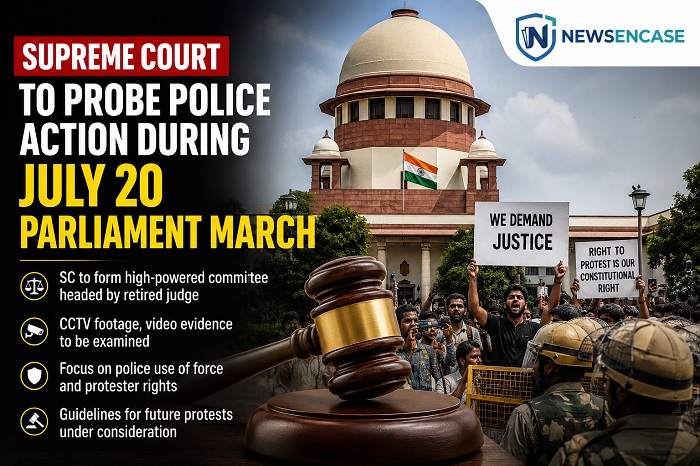
New Delhi: The Supreme Court is set to constitute a high-powered committee to examine allegations and counter-allegations surrounding police action during the July 20 Parliament march involving student protesters in Delhi. The move comes amid competing claims over the use of force, treatment of demonstrators and violence during the protest.
According to reports, the committee will be headed by a retired Supreme Court judge and is expected to include a former High Court Chief Justice and a senior police officer. The panel will undertake a fact-finding exercise into the circumstances surrounding the confrontation between protesters and security personnel.
Supreme Court Seeks Independent Examination
The July 20 march towards Parliament has become the subject of intense legal scrutiny following allegations that police used excessive force to control protesters. Petitioners have raised concerns over alleged physical assaults, detentions and the treatment of female protesters.
The Delhi Police, however, has rejected allegations of excessive force and maintained that officers exercised restraint and used only the force considered necessary to control the situation. Authorities have described the gathering as an unlawful assembly and have initiated investigations into those allegedly involved in the violence.
The Supreme Court has indicated that the proposed committee will examine the allegations from all sides rather than focusing solely on accusations against the police. This is significant because there have also been allegations of violence against police personnel during the protest.
CCTV Footage and Video Evidence to Be Examined
The Supreme Court is also expected to ensure that CCTV recordings and video footage from the July 20 Parliament march are made available to the committee. Such material could help establish the sequence of events and determine how the situation escalated.
The panel is also expected to examine complaints relating to alleged sexual assault, online harassment and targeting of female protesters. The court has stressed that allegations of this nature must be taken seriously and investigated appropriately.
Focus on Police Use of Force
One of the important objectives of the exercise will be to consider guidelines for the graded use of force during protests and public demonstrations. The idea is to establish clearer standards for how law-enforcement agencies should respond when demonstrations become disorderly, while protecting the constitutional right to peaceful protest.
The Supreme Court has also highlighted the importance of protecting students’ rights under Article 19 of the Constitution, which guarantees freedoms including speech and peaceful assembly, subject to reasonable restrictions.
The court is additionally considering whether its powers under Article 142 could be used in appropriate cases to quash FIRs involving students where there is no genuine dispute or serious criminal allegation.
Why the Probe Matters
The Supreme Court-ordered inquiry could have implications beyond the July 20 protest. A clear framework governing crowd control, detention and the use of force could help authorities handle future demonstrations while balancing public order with citizens’ fundamental rights.
The committee’s findings and recommendations are therefore likely to be closely watched by student groups, civil society organisations, law-enforcement agencies and governments. The Supreme Court has indicated that appropriate legal consequences may follow depending on the committee’s findings.
About the Author