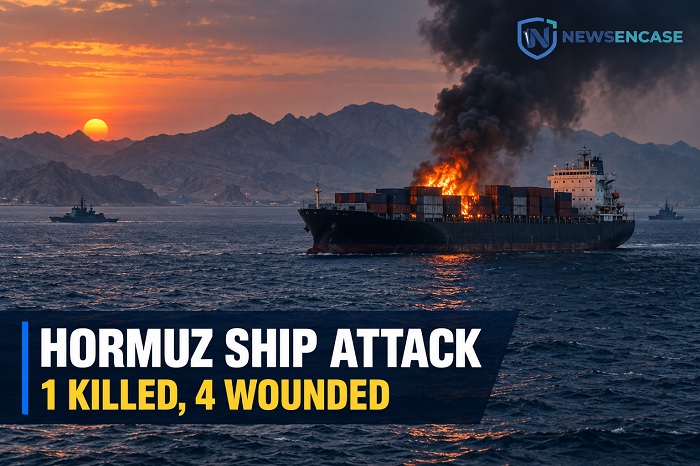
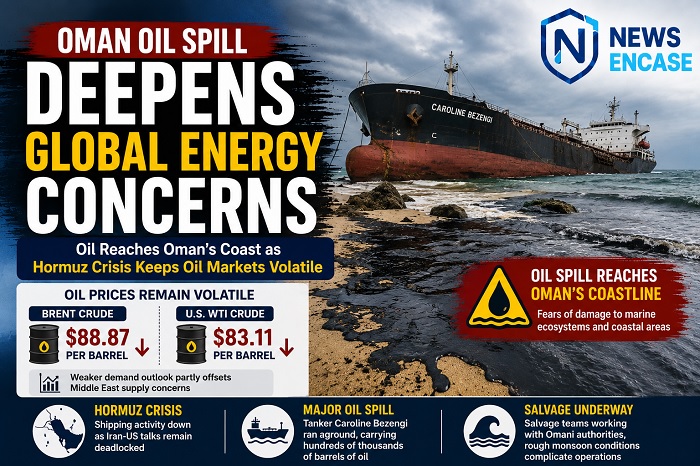
A major oil spill from the tanker Caroline Bezengi has reached Oman’s coastline, raising environmental concerns as Strait of Hormuz tensions keep global oil prices volatile.
Muscat: A major environmental emergency is unfolding along the coast of Oman after oil leaking from the grounded tanker Caroline Bezengi reached parts of the country’s shoreline. The incident is adding to concerns in an already tense regional environment, while uncertainty surrounding the Strait of Hormuz continues to keep global energy markets highly sensitive to supply disruptions.
The tanker, which was carrying an estimated 800,000 barrels of sanctioned Russian crude, ran aground on June 30 after previously reporting problems near Yemen. The vessel has since become the source of a rapidly expanding oil slick. Reuters reported that satellite assessments indicated the slick had spread across more than 2,000 square kilometres, threatening around 40 kilometres of coastline near Ras Madrakah and the Masirah Island region.
Oil Reaches Omani Beaches
Oman’s authorities have confirmed that the pollution has reached parts of the country’s coastline. The affected areas include beaches around Ras Madrakah, while authorities and specialist salvage teams are working to assess the damage and contain the leak.
The spill is particularly concerning because the region contains sensitive marine ecosystems. The waters around the affected area support important wildlife, including Arabian Sea humpback whales and Socotra cormorants. Environmental specialists have warned that continued leakage could cause significant and long-lasting damage to marine habitats.
The situation is being complicated by monsoon winds and difficult sea conditions, which are making salvage and containment operations more challenging. British maritime security company Ambrey has been engaged in salvage operations involving the tanker, according to Reuters.
Risk of a Much Larger Spill
Experts are particularly concerned about the quantity of crude that could potentially escape if the ageing tanker breaks apart. Reuters reported that estimates indicate the vessel could release tens of millions of gallons of crude oil in a worst-case scenario.
Efforts to stabilize the tanker and recover the remaining oil are therefore considered urgent. However, legal and insurance complications have also created additional obstacles to financing and coordinating a large-scale cleanup operation.
Oil Prices Remain Highly Volatile
The environmental crisis comes as global oil markets remain focused on developments around the Strait of Hormuz, one of the world’s most strategically important energy shipping routes.
On Thursday, August 13, Brent crude was around $88.87 per barrel, while U.S. West Texas Intermediate (WTI) was approximately $83.11 per barrel. Both benchmarks edged lower during the session as concerns about weaker global demand partly offset fears over Middle East supply disruptions.
The market nevertheless remains extremely sensitive to developments involving Hormuz. Any prolonged disruption to shipping through the waterway could affect crude supplies, tanker movements, transportation costs and fuel prices across international markets.
The latest oil-price movement also reflects conflicting market forces. While geopolitical risks are supporting prices, concerns about global economic activity and weaker demand expectations are putting downward pressure on crude. U.S. crude inventories also recorded a significant weekly increase, further contributing to market uncertainty.
Hormuz Crisis Adds to Energy-Security Risks
The Oman spill has emerged at a particularly sensitive time for global energy security. Disruptions around Hormuz have already forced traders and shipping companies to reassess routes and supply risks.
For countries heavily dependent on imported crude, prolonged instability could translate into higher transportation and fuel costs. Asian economies are especially exposed because a substantial share of their energy supplies traditionally moves through the broader Gulf shipping network.
For now, authorities are focused on preventing the Oman spill from expanding further. Salvage specialists face the dual challenge of stabilizing the tanker and limiting environmental damage while difficult weather conditions continue.
The combination of a large-scale oil spill, fragile maritime security and uncertainty around the Strait of Hormuz means the situation will remain closely watched by environmental agencies, governments, shipping companies and global energy markets in the days ahead.
About the Author