
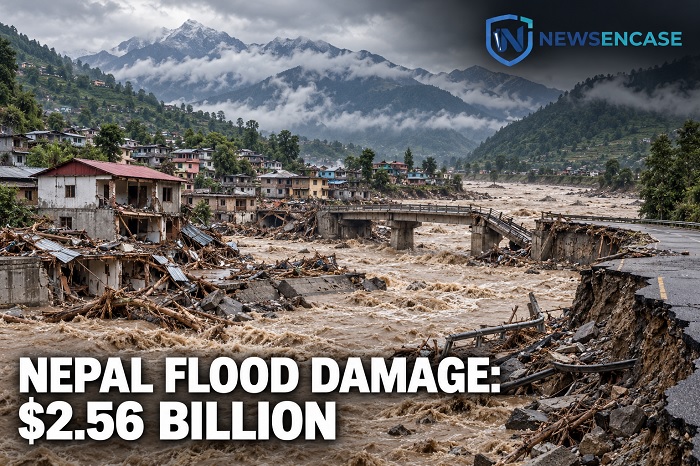
Nepal’s catastrophic floods caused an estimated $2.56 billion in damage, destroying 7,500 homes and affecting hydropower projects as rescue operations continue.
Nepal is confronting an enormous reconstruction challenge after catastrophic flash floods caused an estimated $2.56 billion in damage to homes, public infrastructure and essential services.
According to an initial government assessment, approximately 7,500 houses were completely destroyed, while nearly 20,000 homes may have to be rebuilt. Roads, bridges, drinking-water systems and electricity networks have also suffered extensive damage. Officials cautioned that the financial estimate remains preliminary and could increase following a detailed assessment.
At least 12 hydropower projects—eight operational and four under construction—were affected by the disaster. The damage has disrupted roughly one-tenth of Nepal’s electricity-generating capacity. Nearly 50 suspension bridges were also damaged, with officials indicating that more than half may require complete reconstruction.
The floods were triggered on August 26 after a massive collapse of glacier ice, rock and debris near the Nepal–Tibet border sent a destructive torrent through Himalayan river valleys. Entire settlements were buried, while roads and bridges connecting remote communities were swept away.
As of September 8, the combined death toll across Nepal and neighbouring Tibet had risen to at least 1,399, with more than 5,400 people reported missing. These numbers remain subject to revision as authorities continue identifying victims and reaching inaccessible locations.
Rescue operations are concentrating on three hydropower tunnels where 121 workers may remain trapped. Four people have been rescued from affected project sites, including two workers who survived for nine days inside an air-filled tunnel chamber. Rescue teams are supplying oxygen and using specialised machinery to remove thick layers of mud and debris.
The government estimates that approximately $52.6 million will be required during the first four months for emergency shelters, road repairs, drinking water and electricity restoration. Nepal has also sought international assistance as Prime Minister Balendra Shah’s recently formed administration faces its first major humanitarian and economic crisis.
The disaster has renewed calls for climate-resilient infrastructure and improved emergency-response systems in the Himalayan region, where warming temperatures and unstable glaciers are increasing the risk of destructive floods and landslides.
About the Author