
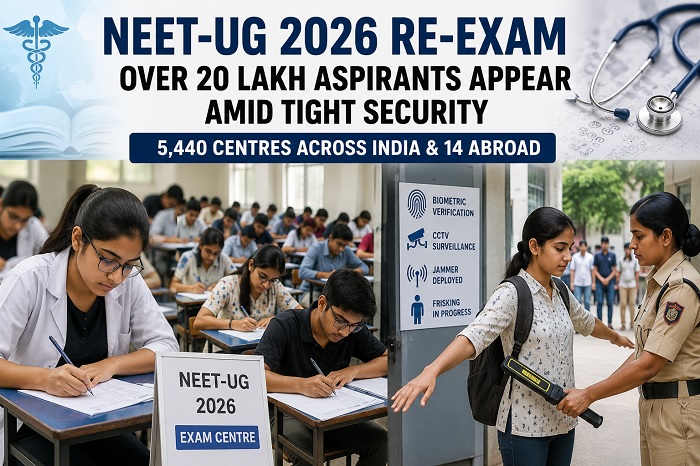
New Delhi, June 22, 2026: More than 20 lakh medical aspirants appeared for the NEET-UG 2026 re-examination on Sunday across 5,440 centres in India and 14 overseas centres, following the cancellation of the original May examination due to a paper leak controversy.
The National Testing Agency (NTA) conducted the nationwide retest under unprecedented security arrangements, deploying biometric verification, CCTV surveillance, jammers, and multi-layer frisking to ensure transparency and fairness.
Candidates who appeared for the examination reported that the paper was more challenging than the cancelled May attempt, particularly due to a lengthy and calculation-intensive Physics section. While Chemistry was considered moderately difficult, most students found the Biology section largely based on NCERT textbooks.
The examination was conducted in 13 languages, including Hindi and English. Special provisions were made for over 10,000 candidates with disabilities, while additional support was provided to 81 students facing serious medical conditions, including a candidate undergoing chemotherapy.
Union Education Minister Dharmendra Pradhan monitored the examination arrangements from the NTA headquarters in Delhi and reviewed the extensive logistical and technical measures implemented for the smooth conduct of the test.
In a notable gesture, Prime Minister Narendra Modi reportedly remained at Delhi airport after arriving from Kolkata to avoid traffic disruptions that could affect NEET candidates travelling to examination centres.
Several states extended support to students and parents by arranging drinking water, food, medical assistance, ambulances, shaded waiting areas, and free transportation services.
The re-examination also witnessed isolated incidents. In Bhopal, two candidates were denied entry after reaching their centre late following a road accident. In Rajasthan’s Ajmer, a candidate alleged she was initially denied entry due to her attire, though the NTA later clarified that she was allowed to appear for the examination.
According to the NTA, more than 95,000 examination rooms were monitored through 1.38 lakh CCTV cameras, while over 51,000 jammers were deployed to prevent electronic malpractice. Around seven lakh officials, including police personnel, observers, and examination staff, were mobilised nationwide for the conduct of the examination.
The NEET-UG 2026 re-exam marks one of the largest and most heavily monitored entrance examinations ever conducted in India, as authorities seek to restore confidence in the country’s premier medical entrance test following the paper leak controversy.
About the Author