
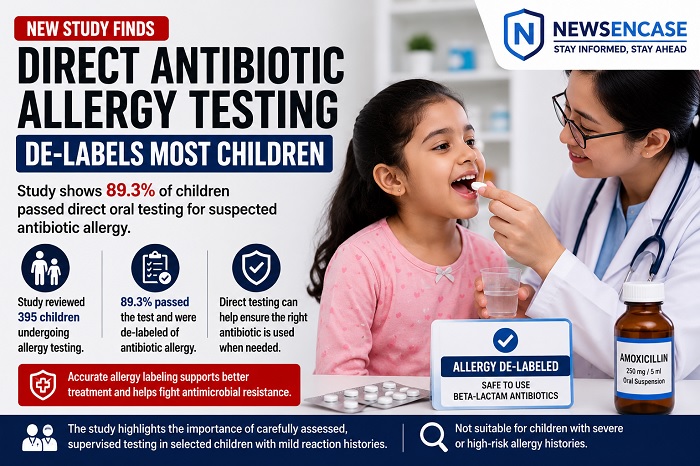
A new Singapore study found that 89.3% of selected children passed direct oral beta-lactam allergy testing, supporting safer antibiotic allergy de-labelling.
A new study has found that most children carrying a suspected beta-lactam antibiotic allergy label can potentially be cleared of that label after supervised direct oral allergy testing. The findings add to growing evidence that carefully selected children with mild reactions may not need extensive allergy testing before doctors determine whether they can safely receive the antibiotic again.
Researchers from Singapore reviewed 395 children who underwent 425 beta-lactam drug provocation tests (DPTs) for suspected antibiotic hypersensitivity. Beta-lactam antibiotics include commonly used medicines such as penicillins and cephalosporins.
Among children who underwent diagnostic direct oral DPTs to the suspected antibiotic, 89.3% successfully passed the test, allowing them to have their antibiotic-allergy label removed. The results suggest that a substantial proportion of childhood antibiotic-allergy labels may not represent a confirmed allergy.
What Is Direct Antibiotic Allergy Testing?
A drug provocation test involves giving a patient a suspected medicine under controlled medical supervision and monitoring for a reaction. For appropriately selected children, the direct approach can bypass an initial skin-testing step.
This is particularly relevant because childhood rashes occurring during antibiotic treatment can sometimes be caused by an underlying viral infection or may represent a side effect rather than a true drug allergy. An incorrect allergy label can remain in a patient’s medical record for years.
Why Removing an Incorrect Allergy Label Matters
Being incorrectly labelled allergic to penicillin or another beta-lactam antibiotic can affect future treatment decisions. Doctors may choose broader-spectrum or alternative antibiotics when first-line medicines could otherwise have been appropriate.
According to the study report, removing inaccurate allergy labels could therefore support antimicrobial stewardship, improve access to preferred antibiotics and potentially help reduce unnecessary use of broader-spectrum medicines.
Testing Is Not Suitable for Every Child
The researchers stressed that direct testing should not be generalized to children with severe immediate reactions, severe cutaneous adverse reactions or other high-risk allergy histories. In the study, most reactions occurring during diagnostic direct oral testing were mild skin reactions, but serious reactions were also reported, including one case of anaphylaxis.
The study was retrospective and conducted in a Singapore paediatric population, so further research is needed before the approach can be broadly applied to every child.
Overall, the findings strengthen the case for risk-based antibiotic allergy assessment. For children with carefully assessed, mild reaction histories, supervised direct oral testing could offer a simpler route to determining whether an antibiotic allergy label is still appropriate.
About the Author


