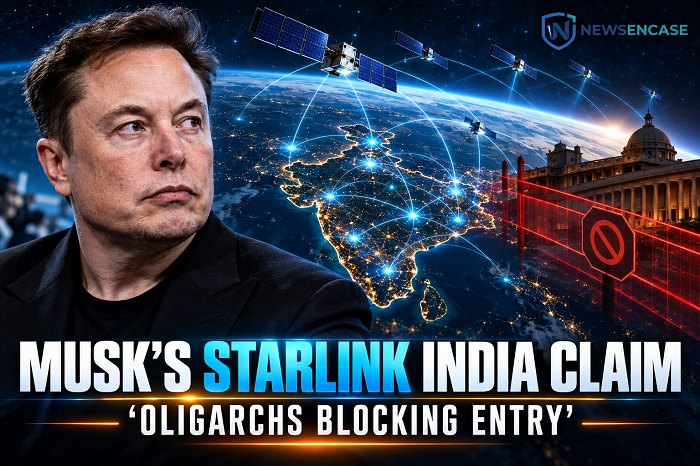
Elon Musk has alleged that oligarchs are delaying Starlink’s India launch, while the government says its satellite approval process is fair and non-discriminatory.
Elon Musk has alleged that powerful business interests are obstructing Starlink’s entry into India to protect their position in the country’s telecommunications market.
The SpaceX chief claimed that “certain oligarchs” were blocking the satellite-internet service to maintain a “monopolistic chokehold” on Indian consumers. Musk did not identify any individual or company or provide evidence supporting the allegation.
India’s telecommunications ministry rejected the accusation, describing the country’s satellite-communications framework as fair and non-discriminatory.
Indian Government Rejects Musk’s Allegation
The ministry said three satellite-communications applicants were at broadly the same regulatory stage, with security assessments still underway. Starlink, Reliance Jio’s satellite venture and Bharti Airtel-backed Eutelsat OneWeb have secured preliminary approvals but are awaiting spectrum assignments and final clearances.
“The suggestion that the framework or its application is unfair or discriminatory is baseless and misconceived,” the government said in its response.
Reliance Jio and Bharti Airtel had not publicly responded to Musk’s remarks at the time of the initial reports.
Why Has Starlink’s India Launch Been Delayed?
Starlink has sought permission to begin commercial services in India for several years. Although it has obtained key telecom authorisations, possessing a licence does not automatically permit a company to use satellite spectrum.
India’s Department of Telecommunications states that operators require a separate frequency assignment from its Wireless Planning and Coordination wing. Satellite providers must also satisfy rules involving security, lawful interception, domestic gateways and the routing of Indian traffic.
Starlink has reportedly submitted a new application to IN-SPACe for its second-generation satellite constellation. The proposal includes low-Earth-orbit satellites and direct-to-device connectivity capabilities.
Security scrutiny intensified after authorities recovered Starlink equipment during separate operations in the Andaman and Nicobar Islands and Manipur in 2024. Musk has maintained that Starlink’s beams were switched off over India and that its services were not operational in the country at the time.
Competition in India’s Satellite-Internet Market
The disagreement comes after earlier differences over how satellite spectrum should be distributed. Musk supported administrative allocation, while some Indian telecom operators initially favoured auctions.
Starlink later signed separate agreements with Reliance Jio and Bharti Airtel to distribute its equipment in India, subject to regulatory approval. Despite those partnerships, a commercial launch date has not been announced.
India is considered an important potential market for satellite broadband because the technology can connect remote areas where conventional mobile towers and fibre networks are difficult to deploy. However, pricing, equipment costs, spectrum conditions and security requirements will influence Starlink’s ability to compete with established operators.
For now, Musk’s accusation remains an unsubstantiated claim. Starlink cannot begin full commercial operations until it receives all remaining regulatory and spectrum clearances.
About the Author