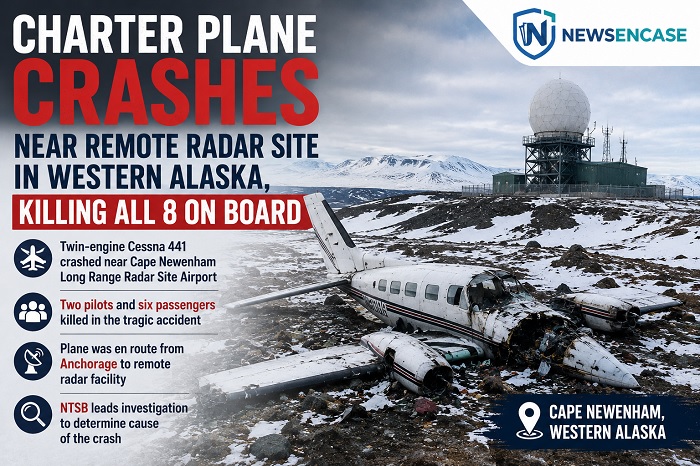
Anchorage: A charter aircraft carrying eight people crashed near a remote military radar site in western Alaska on Thursday, killing everyone aboard, according to US military officials. The accident occurred near the Cape Newenham Long Range Radar Site Airport, about 450 miles (725 km) west of Anchorage.
The aircraft, a twin-engine Cessna 441 operated by Security Aviation, had departed Anchorage and was headed toward Cape Newenham. According to preliminary information released by aviation authorities, the plane crashed at about 12:15 p.m. local time while approaching the remote airport. The National Transportation Safety Board (NTSB) said there were two pilots and six passengers on board.
The crash initially triggered a search-and-rescue operation after authorities received an alert about an aircraft incident near the Cape Newenham Long Range Radar Site. The Alaska Rescue Coordination Center, Alaska State Troopers and other agencies responded to the remote location. The US Coast Guard and Alaska National Guard were also involved in the emergency response.
The US military later confirmed that all eight people aboard had died. The Alaskan Command described the incident as a devastating loss and said the victims were professionals carrying out a vital mission in a demanding environment. Authorities have said the names of those killed will be released after their families are notified.
The US Army Corps of Engineers (USACE) confirmed that it had chartered the flight and said two of its employees were among those killed. The agency said next of kin had been notified and that it was coordinating with local, state and federal authorities. Further information about the victims is expected to be released when appropriate.
Cape Newenham is an extremely remote location in western Alaska and forms part of a network of radar installations used to monitor aircraft activity in Alaska’s airspace and along its borders. The radar facility is managed by the Pacific Air Forces Regional Support Center. The airport primarily supports military and authorized charter operations, making access to the area particularly challenging.
The cause of the Alaska plane crash remains unknown. Investigators have not announced whether mechanical problems, weather conditions, pilot issues or another factor contributed to the accident. Officials have also not indicated whether the aircraft reported an emergency before going down.
The NTSB is leading the investigation, with the Federal Aviation Administration (FAA) assisting. Investigators are expected to examine the wreckage, reconstruct the aircraft’s flight path and determine what happened during its approach to Cape Newenham. Officials have stressed that the investigation is still in its early stages and that no cause has yet been established.
Alaska Senator Lisa Murkowski expressed condolences to the victims’ families and praised emergency personnel involved in the response. She also said she had travelled extensively with Security Aviation and had met its pilots. Other Alaska officials also offered condolences as authorities continued recovery and investigative operations.
The tragedy adds to the risks associated with aviation in Alaska, where vast distances, isolated communities and difficult terrain can make emergency response particularly challenging. However, investigators have not linked the crash to any specific environmental or operational factor at this stage.
As the investigation continues, federal authorities are expected to release additional information about the victims, aircraft and circumstances surrounding the crash once families have been notified and more evidence becomes available.
About the Author