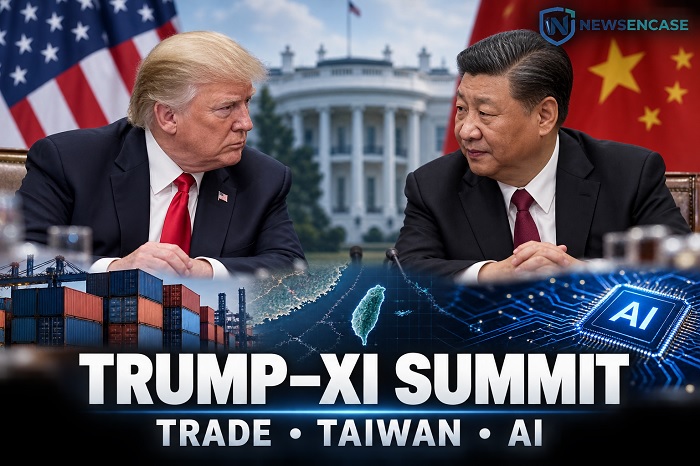
Donald Trump and Xi Jinping extended the US-China trade truce but remained divided over Taiwan, artificial intelligence and strategic competition.
US President Donald Trump and Chinese President Xi Jinping concluded high-level talks at the White House on September 24, seeking to stabilise relations between the world’s two largest economies without resolving their major disagreements.
The summit produced a short extension of the US-China trade truce but no major breakthrough on tariffs, Taiwan, artificial intelligence or technology restrictions. Here are five key takeaways from the closely watched meeting.
1. Trade Truce Extended for Two Months
The most concrete outcome was an agreement to extend the existing trade arrangement by two months, reportedly moving its expiry to January 10, 2027.
The temporary extension prevents an immediate return to an escalating tariff conflict and gives negotiators additional time to address Chinese purchases of American products, rare-earth supplies and restrictions on sensitive technologies.
China has reportedly met its commitment to purchase 25 million tonnes of US soybeans but remains behind schedule on approximately $17 billion in other agricultural purchases. American officials have also raised concerns about the supply of rare-earth minerals used in defence equipment, electric vehicles and advanced electronics.
The limited extension therefore provides economic breathing room without delivering the durable agreement sought by businesses and investors.
2. Taiwan Remains the Most Dangerous Dispute
Xi used the meeting to urge Washington to handle Taiwan with caution and adopt a clearer position against Taiwanese independence.
That language goes beyond the United States’ traditional position that it does not support Taiwan’s independence. Washington has generally avoided explicitly opposing independence while providing Taiwan with defensive weapons.
Trump did not announce any change in US policy. However, attention remains focused on a delayed arms package for Taiwan reportedly worth around $14 billion.
Any concession involving Taiwan could face resistance in Congress and concern among US partners in the Indo-Pacific. Beijing considers Taiwan part of China and has not ruled out using force to establish control over the self-governed island.
3. Trump and Xi Remain Divided on AI Regulation
Artificial intelligence emerged as another major area of disagreement.
Trump has expressed opposition to creating additional AI restrictions, arguing that existing laws and the US Justice Department should address harmful activity. Xi, meanwhile, stressed that powerful AI systems must remain under human control and serve public welfare.
Before the summit, US officials had discussed creating an AI incident-notification mechanism between Washington and Beijing. Such a channel could allow both governments to communicate during AI-related events affecting national security.
However, no formal AI hotline or safety agreement was publicly announced following the meeting. Competition over advanced chips, AI models and computing infrastructure is therefore expected to continue.
4. Both Leaders Want to Prevent Competition From Becoming Conflict
Xi again referred to the “Thucydides Trap”—the theory that conflict can occur when a rising power challenges an established one—but said such an outcome could be avoided.
He called for stronger crisis-prevention mechanisms and regular military communication. Trump also emphasised cooperation, referring to historical periods when the United States and China pursued shared objectives.
The statements reflect a mutual interest in preventing trade and technology competition from escalating into a direct military confrontation. However, disputes involving Taiwan, the South China Sea and military activity in the Indo-Pacific remain unresolved.
5. Ceremony Overshadowed Concrete Outcomes
Xi’s first visit to Washington in more than a decade featured a red-carpet welcome, military honours, aircraft flyovers and a White House state dinner.
Trump also personally welcomed Xi at Joint Base Andrews—an unusual gesture for an American president—and later showed him the redesigned White House grounds.
Despite the elaborate ceremony, the private meeting reportedly lasted around 90 minutes, and neither government immediately issued a comprehensive account of the discussions.
The contrast between the grand reception and the limited policy outcomes reinforced the impression that the summit was primarily intended to maintain dialogue and display stability rather than secure a comprehensive agreement. The White House had presented the visit as an important milestone in bilateral relations.
The meeting lowered the immediate risk of another trade confrontation, but disagreements over Taiwan, AI, rare earths and technology controls remain central to the increasingly competitive US-China relationship.
About the Author