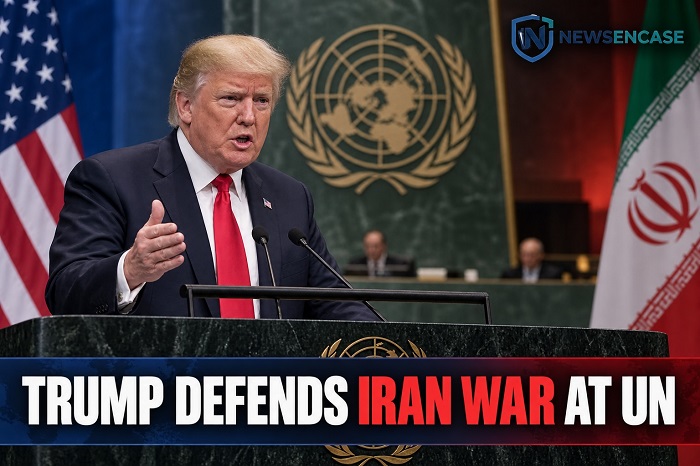
Donald Trump defended the US campaign against Iran at the United Nations, warning Tehran of further action while signalling that a peace agreement remains possible.
US President Donald Trump defended Washington’s military campaign against Iran during a forceful address to the United Nations General Assembly, while leaving open the possibility of negotiations to end the conflict.
Speaking to world leaders in New York on September 22, Trump portrayed the war as necessary to prevent Iran from developing nuclear weapons and expanding its influence across the Middle East. He argued that earlier diplomatic efforts and sanctions had failed to remove the threat.
The US president presented Tehran with a stark choice between reaching an agreement with Washington and facing further military action.
Trump Issues Warning to Iran
Trump said he had a “big decision” to make over the future of the conflict. He suggested Iran could negotiate an agreement that would allow it to rebuild, but also threatened to “annihilate” the Islamic Republic if it refused US terms.
Despite the aggressive rhetoric, Trump predicted that an agreement could be reached after the US midterm elections scheduled for November 3.
He reiterated that Washington would not allow Iran to possess nuclear weapons and accused Tehran of financing armed groups and destabilising the region. Iran has repeatedly maintained that its nuclear programme is intended for peaceful purposes.
Trump also called on Iran to fully reopen the Strait of Hormuz, a crucial route for global energy shipments, and return to negotiations. Disruptions in the waterway have contributed to concerns about oil supplies and higher energy prices.
Trump Defends US-Israel Military Campaign
The president described the US-Israel campaign as a response to what he called a long-standing security threat. He claimed that American military operations and economic pressure had significantly weakened Iran.
However, the conflict has continued for several months without a comprehensive peace agreement, raising questions about civilian casualties, regional stability and the economic consequences of prolonged fighting.
Iran’s delegation reportedly walked out during Trump’s criticism of the country. Tehran has accused Washington and Israel of violating international law and has demanded an end to the military campaign before meaningful negotiations can resume.
Ukraine, AI and Other Issues Raised at UN
Trump also used the 37-minute address to outline his administration’s broader foreign-policy priorities.
On the Russia-Ukraine war, he said the United States was working with leaders from both countries and predicted that progress could come sooner than expected.
The president rejected calls for tighter international regulation of artificial intelligence and said the United States intended to maintain its technological lead. He also criticised the International Criminal Court and defended his administration’s actions involving Venezuela, Cuba and drug cartels.
Trump’s address combined threats of further military action with an offer of diplomacy, but he did not provide details about possible negotiations with Tehran or the conditions Iran would have to accept.
The speech therefore left the future of the conflict uncertain, with the next steps likely to depend on military developments, energy-market pressure and whether Washington and Tehran can reopen diplomatic channels.
About the Author