
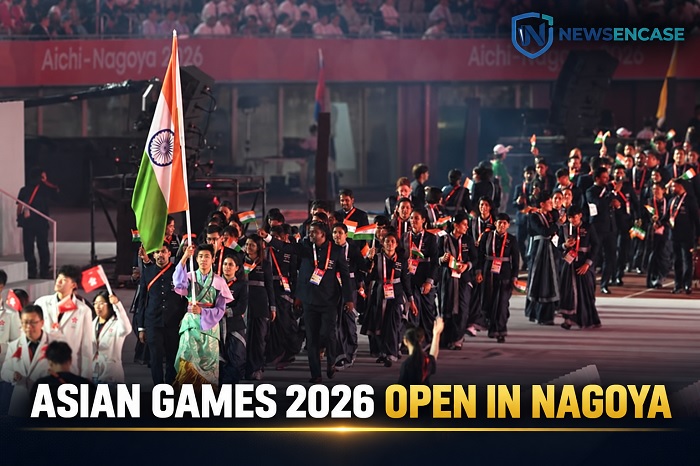
The 2026 Asian Games have opened in Nagoya with a spectacular ceremony as Manu Bhaker and Pawan Sehrawat led the Indian contingent.
The 20th Asian Games officially opened in Nagoya, Japan, on September 19, 2026, with a colourful ceremony combining traditional Japanese culture, music, dance, fireworks and advanced visual technology.
Emperor Naruhito formally declared the Games open at the Paloma Mizuho Stadium as athletes and officials representing 45 nations and regions joined the parade.
The sporting event will continue across Aichi Prefecture and Nagoya until October 4.
Ceremony Celebrates Asian Unity
Directed by Japanese filmmaker Yukihiko Tsutsumi, the opening ceremony followed the theme “Harmonic Heart Beat.” Performances highlighted unity and cultural diversity while presenting Japan’s blend of tradition and technological innovation.
The participating delegations entered the stadium during the athletes’ parade before the ceremonial lighting marked the formal beginning of the competition.
Japan is hosting the Asian Games for the third time, following Tokyo in 1958 and Hiroshima in 1994.
According to Reuters, approximately 11,000 athletes will compete across 43 sports during the two-week event. Esports, teqball and virtual taekwondo are among the newer disciplines on the programme.
Manu Bhaker and Pawan Sehrawat Lead India
Olympic medallist Manu Bhaker and kabaddi star Pawan Sehrawat carried the Indian flag during the opening ceremony.
Shot-putter Tajinderpal Singh Toor had initially been selected as the male flagbearer but was replaced at the last minute after his official ceremonial kit failed to arrive on time.
The Indian Olympic Association confirmed the change before the ceremony. Toor remains one of India’s leading athletics medal prospects at the Games, the Indian Express reported.
India recorded its best Asian Games performance in Hangzhou, winning 107 medals, including 28 golds. The contingent will now seek to surpass that historic total in Japan.
Games Begin After Logistical Concerns
The opening followed reports of accommodation, transport and registration difficulties during preparations.
Organisers chose not to construct a dedicated athletes’ village. Participants have instead been accommodated in hotels, temporary wooden units and a cruise ship as part of a cost-saving and sustainability strategy.
Some delegations raised concerns about the arrangements, although the Olympic Council of Asia described the difficulties as manageable. Accommodation provisions are serving more than 17,000 registered athletes and officials, according to the Associated Press.
With the ceremony completed, attention now shifts to the competition as Asia’s leading athletes pursue medals across Nagoya and the wider Aichi region.
About the Author