
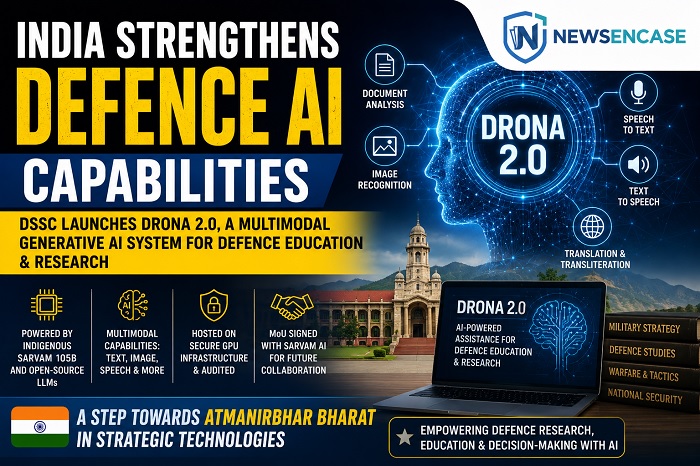
New Delhi: India has taken another significant step towards strengthening its indigenous artificial intelligence capabilities in the defence sector with the launch of DRONA 2.0, an advanced multimodal generative AI platform developed for military education, training, research and strategic studies.
The upgraded platform has been launched by the Defence Services Staff College (DSSC), Wellington, and is designed to provide AI-powered support to faculty members, students and defence researchers. DRONA 2.0 integrates the indigenous Sarvam 105B large language model along with selected open-source large language models, creating a specialised AI ecosystem focused on defence and strategic applications.
The name DRONA stands for DSSC Resource Optimising Neural AI. The original DRONA platform was initially developed as a customised GPT and launched on the DSSC Wide Area Network in June 2025. With DRONA 2.0, the system has been significantly upgraded with multimodal capabilities that allow it to process and generate information across different formats rather than relying only on text-based interactions.
One of the most important features of DRONA 2.0 is its ability to support reasoning, document analysis, image recognition, image generation, speech-to-text, text-to-speech, translation and transliteration. The platform can also assist with the creation of podcasts, PowerPoint presentations and data analytics, potentially making it a powerful research and learning tool for defence professionals.
The system has been pre-trained using a large repository of academic material available at DSSC. This is expected to help faculty members and students access relevant information more efficiently while supporting advanced research in military affairs, defence strategy and related academic disciplines.
According to reports, DRONA 2.0 is hosted on a state-of-the-art GPU server and underwent an extensive audit before deployment. The platform was certified by the Headquarters Integrated Defence Staff (HQ IDS) and the Defence Cyber Agency, highlighting the importance of security and validation when deploying generative AI systems in a sensitive defence environment.
The launch was attended by Lt Gen Manish Erry, Commandant of DSSC, and Vivek Raghavan, co-founder of Sarvam AI. DSSC and Sarvam AI also signed a Memorandum of Understanding to collaborate on the future development of DRONA GPT and other AI-based applications.
The development is being seen as an important move in India’s broader push towards AI self-reliance and sovereign technology capabilities. By combining an indigenous foundation model with open-source AI technologies, DRONA 2.0 could reduce dependence on external platforms while allowing defence institutions to build AI systems tailored to Indian requirements.
The platform is also significant because defence organisations worldwide are increasingly exploring artificial intelligence for training, research, intelligence analysis, logistics, simulation and decision-support systems. However, the use of AI in military environments requires strong safeguards related to cybersecurity, data protection and human oversight.
With DRONA 2.0, DSSC aims to bring advanced generative AI directly into the defence education and research ecosystem. The initiative could eventually serve as a model for other military and strategic institutions looking to develop secure, specialised and indigenous AI platforms.
As India continues to invest in artificial intelligence infrastructure and domestic AI models, DRONA 2.0 represents another important milestone in integrating emerging technologies into national defence capabilities. Its future development and adoption will be closely watched as the country expands its focus on AI-driven military education, strategic research and technological self-reliance.
About the Author