
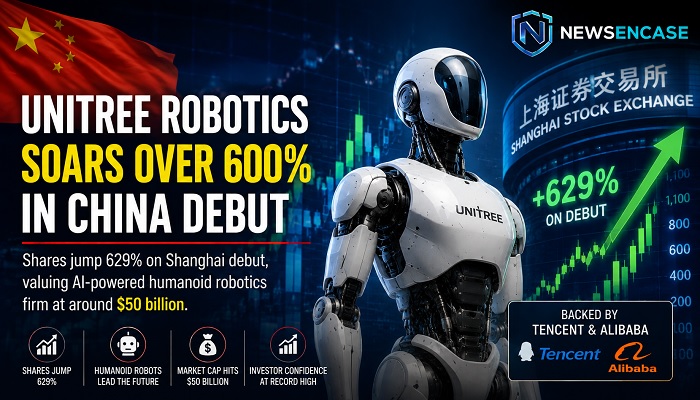
Shanghai: Chinese humanoid robotics company Unitree Robotics has made a spectacular debut on the Shanghai Stock Exchange’s STAR Market, with shares surging as much as 629% above the initial public offering (IPO) price. The blockbuster listing has placed the spotlight firmly on China’s rapidly expanding artificial intelligence and humanoid robotics industry.
Unitree had priced its IPO at 150.80 yuan per share and raised approximately 6.1 billion yuan ($904 million). During Wednesday’s trading session, the stock climbed as high as 1,100 yuan before giving up some of its gains. By the close, shares were still about 460% above the IPO price, giving the company a market value of roughly $50 billion.
The extraordinary market performance reflects growing investor confidence in robotics as China seeks to strengthen its position in artificial intelligence, automation and advanced manufacturing. Unitree has become one of the country’s best-known robotics companies, developing both humanoid machines and quadruped robots capable of walking, running, dancing and performing complex movements.
The company, founded in Hangzhou in 2016, has attracted backing from major technology investors, including Tencent and Alibaba, and has gained international attention through demonstrations of its robots. Unitree reported approximately 1.7 billion yuan ($250 million) in revenue in 2025, with more than 40% of sales coming from overseas markets.
Investor demand for the IPO was already exceptionally strong before trading began. The retail portion of the offering was reportedly oversubscribed by more than 8,000 times, highlighting the enthusiasm surrounding China’s robotics sector. Unitree plans to use the IPO proceeds to expand research and development, improve production capacity and support the development of new robotic products.
However, analysts caution that the sector still faces significant challenges. Humanoid robots remain relatively expensive and many current deployments are focused on demonstrations, research and limited commercial applications rather than widespread everyday use. Unitree also faces geopolitical hurdles, including US restrictions affecting future imports of certain foreign-made robots.
Despite these challenges, Unitree’s market debut represents a major milestone for China’s robotics industry. The huge jump in its share price signals strong investor appetite for companies operating at the intersection of AI, robotics and automation, while potentially encouraging other Chinese robotics firms to pursue public listings and accelerate development.
About the Author


