Iran has rejected Donald Trump’s claim that the US has total control over the Strait of Hormuz, as tensions over the strategic oil route continue to disrupt global shipping and energy markets.
Tehran: Tensions between Iran and the United States have intensified over the strategic Strait of Hormuz, with Tehran rejecting US President Donald Trump’s claim that Washington has “total control” over the crucial maritime corridor.
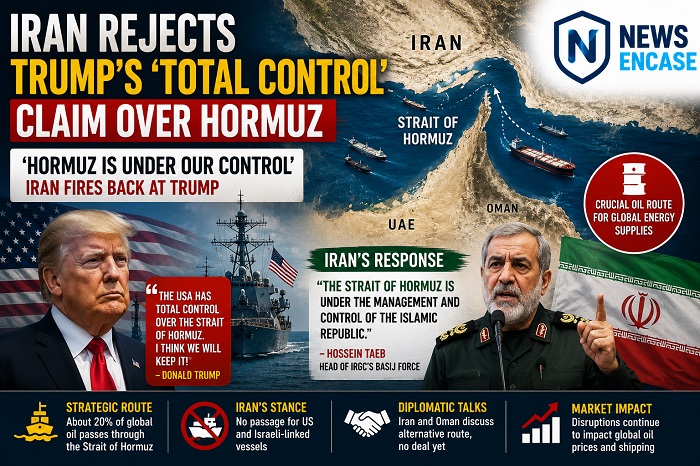
Hossein Taeb, head of Iran’s Basij paramilitary force, said on Iranian state television that the waterway remained under the “management and control” of the Islamic Republic. His remarks directly challenged Trump’s assertion that the United States had established control over the passage.
The dispute comes amid an ongoing confrontation that has severely disrupted shipping through one of the world’s most important energy routes. The Strait of Hormuz connects the Persian Gulf with the Gulf of Oman and is a critical passage for international oil and gas shipments.
Trump Claims US Has ‘Total Control’
Trump said on Wednesday that the United States had total control of the Strait of Hormuz and indicated that Washington intended to maintain that position. He has also described the US naval blockade in the region as a “wall of steel.”
Washington has maintained that its naval presence is aimed at enforcing the blockade on Iran while facilitating freedom of navigation for vessels that are not involved with Iran. US Defense Secretary Pete Hegseth said Thursday that the US military has sufficient resources to maintain its naval blockade of Iranian ports indefinitely by rotating forces in the region.
Iran Maintains Restrictions on Shipping
Tehran, meanwhile, continues to insist that vessels require Iranian permission to pass through the waterway. Iranian officials have also said that vessels connected to Israel and the United States will not be permitted to transit under current conditions.
Iranian Foreign Minister Abbas Araghchi separately accused Washington of making another major strategic miscalculation over Hormuz, warning that the US assessment of the situation could lead to further escalation.
The competing claims reflect the wider military and diplomatic standoff between Tehran and Washington, with negotiations over reopening the waterway currently stalled.
Shipping Traffic Remains Severely Disrupted
Despite Washington’s claims of control, maritime traffic through Hormuz remains far below normal levels. Reuters reported that traffic had fallen to six vessels in one recent period, compared with a 10-day average of about 11 vessels.
The disruption has had significant consequences for global energy markets. The US Energy Information Administration has raised its oil-price forecast, citing expectations that severe disruptions through Hormuz could continue during August.
Brent crude recently settled around $88.91 a barrel, while US West Texas Intermediate crude was around $83.20, as markets continued to assess the risk of prolonged supply disruptions.
Oman Diplomacy Offers Possible Route Forward
Diplomatic efforts involving Iran and Oman are also continuing over possible arrangements for restoring maritime traffic. Discussions have focused on establishing alternative routes and mechanisms that could allow shipping to resume, although no final agreement has yet resolved the wider dispute.
For global markets, the central concern remains how long the disruption will last. Prolonged restrictions through Hormuz could continue affecting oil prices, shipping costs, insurance premiums and inflation across major economies.
With Iran insisting that the waterway remains under its control and Washington maintaining its naval pressure, the Strait of Hormuz has become one of the most important flashpoints in the wider US-Iran confrontation. Further diplomatic negotiations and developments at sea will determine whether normal commercial shipping can gradually resume.
About the Author