
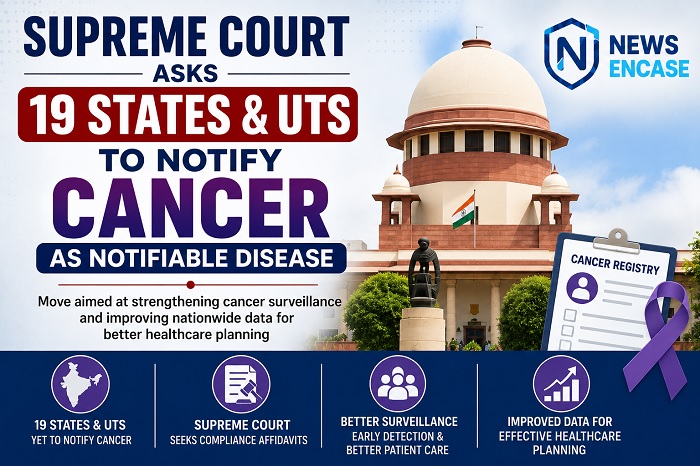
The Supreme Court has asked 19 remaining states and Union Territories to consider declaring cancer a notifiable disease to improve reporting, surveillance, early detection and patient care.
New Delhi: The Supreme Court of India has asked 19 states and Union Territories that have not yet done so to consider declaring cancer a “notifiable disease”, with the aim of improving cancer surveillance, supporting earlier detection and ensuring better patient care across the country.
The direction was issued by a bench headed by Chief Justice of India Surya Kant, along with Justices Joymalya Bagchi and V. Mohana, while hearing a Public Interest Litigation seeking nationwide notification of cancer.
The court was informed that 17 of India’s 36 states and Union Territories have already notified cancer as a notifiable disease, following recommendations made by a Parliamentary Standing Committee on Health and Family Welfare. The remaining 19 states and UTs have been asked to consider the recommendations and take appropriate decisions. They have also been directed to file compliance affidavits.
Why Cancer Notification Matters
Declaring a disease “notifiable” generally means that healthcare providers or relevant authorities are required to report diagnosed cases to government health systems. For cancer, a more consistent reporting mechanism could help authorities develop a clearer picture of the disease burden across different regions.
The Supreme Court’s intervention comes amid concerns over fragmented cancer data and uneven surveillance, particularly in areas where reporting systems are less comprehensive. The PIL argued that the absence of mandatory reporting can contribute to gaps in cancer statistics and make it more difficult for policymakers to plan prevention, diagnosis and treatment programmes.
Better reporting could help health authorities identify regional patterns, monitor changes in cancer incidence and allocate medical resources more effectively.
Court Questions Lack of Uniform Guidelines
During the hearing, the Supreme Court also questioned the Centre about the absence of uniform mandatory guidelines for all states and Union Territories. The Centre’s representative pointed out that health is primarily a state subject and noted that 17 states had already notified cancer.
The court nevertheless stressed the importance of a consistent policy and asked the remaining jurisdictions to consider the Parliamentary Standing Committee’s recommendations.
PIL Seeks Nationwide Cancer Registry
The case originated from a PIL filed by Dr Anurag Srivastava, a former AIIMS Delhi surgeon and researcher. The petition seeks nationwide mandatory reporting of cancer cases and has also called for a unified, real-time digital cancer registry to improve the collection and use of cancer-related information.
The petition argued that inconsistent reporting can contribute to disparities in cancer surveillance, potentially affecting early diagnosis, treatment planning and healthcare policy.
The Parliamentary Standing Committee on Health and Family Welfare had also recommended classifying cancer as a notifiable disease in its report on cancer care, prevention, diagnosis, research and treatment affordability.
What Happens Next
The 19 states and Union Territories will now have to consider the recommendations and submit their compliance responses to the Supreme Court. If implemented more widely, cancer notification could create a more comprehensive national reporting framework and provide policymakers with better data for planning cancer prevention and treatment services.
The move represents an important step toward standardising cancer surveillance in India, although notification alone will not solve the country’s cancer-care challenges. Effective screening, timely diagnosis, affordable treatment, specialist availability and public awareness will remain essential to improving outcomes.
About the Author


