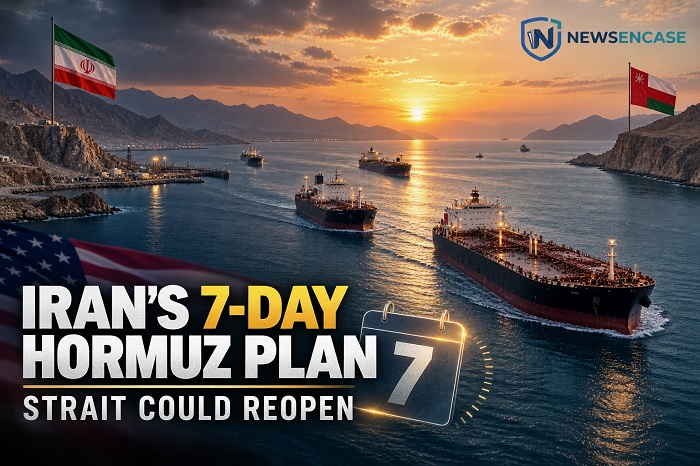
Iran has offered to reopen the Strait of Hormuz within seven days if the US lifts its naval blockade, waives oil sanctions and supports a regional ceasefire.
Iran has submitted a seven-day proposal to the United States that could reopen the Strait of Hormuz, end regional hostilities and restart negotiations over Tehran’s nuclear programme.
Iranian Foreign Minister Abbas Araghchi said the timetable would begin as soon as Washington formally accepted the plan. He described the proposal as a concrete pathway towards restoring normal commercial shipping through one of the world’s most important energy corridors.
The United States had not publicly accepted the proposal at the time of reporting. White House officials said discussions through mediators were positive and constructive but did not provide a detailed response to Iran’s conditions.
What Iran Is Demanding From the US
Under the reported proposal, Washington would be required to lift its naval blockade of Iranian ports, grant waivers allowing Iranian oil exports and facilitate the release of approximately $12 billion in frozen Iranian assets.
The plan also calls for hostilities to stop across the region, including in Lebanon. Some accounts indicate that Iran wants the ceasefire arrangements to cover Yemen as well.
In return, Iran would reopen the Strait of Hormuz and begin negotiations with the United States over a longer-term agreement covering its nuclear programme and other disputed issues.
Araghchi said the initial measures could be completed within four or five days. The strait would reopen on the sixth day, followed by negotiations on a final agreement on day seven.
Plan Builds on Collapsed June Agreement
The latest proposal closely resembles a memorandum of understanding negotiated by Iran and the United States in June through Qatari and Pakistani mediation.
That agreement provided a 60-day period for broader negotiations. It included measures concerning sanctions, oil exports, the naval blockade and commercial traffic through the Strait of Hormuz.
However, the arrangement collapsed within weeks amid disputes over the administration of shipping through the waterway and alleged violations by both sides. Military attacks subsequently resumed, and President Donald Trump declared the deal over in July.
Iran’s new proposal compresses many of those commitments into seven days. Araghchi said the actions requested from Washington were already contained in the earlier memorandum.
Why the Strait of Hormuz Matters
The Strait of Hormuz is a narrow maritime passage between Iran and Oman linking the Persian Gulf with the Arabian Sea.
Before the conflict, approximately one-fifth of globally traded oil and gas passed through the waterway. Disruption to tanker traffic has increased shipping and insurance costs while contributing to higher international energy prices.
Control over access to Hormuz has become Iran’s most important source of leverage in negotiations with Washington. Gulf economies also depend heavily on the route, although Saudi Arabia and the United Arab Emirates operate or are developing pipelines intended to bypass it.
Reports of Iran’s willingness to reopen the strait have previously caused oil prices to fall as traders assessed the possibility of restored supplies. However, analysts warn that prices could remain volatile until an enforceable agreement is signed and normal tanker traffic resumes.
US Response Remains Unclear
The Trump administration has not formally endorsed the seven-day timetable. A White House official said American representatives were holding constructive discussions through intermediaries.
Trump has accused Tehran of delaying an agreement until after the US midterm elections in November. Araghchi said it would be preferable to reach a deal before the elections but insisted that Iran was not setting its policy according to the American political calendar.
Saudi Arabia has reportedly expressed scepticism about the proposal, while Qatar continues to support mediation efforts.
The plan remains an offer rather than an agreement. Its implementation depends on Washington and Tehran resolving disputes over sanctions relief, frozen assets, regional ceasefires, maritime security and Iran’s nuclear activities.
About the Author