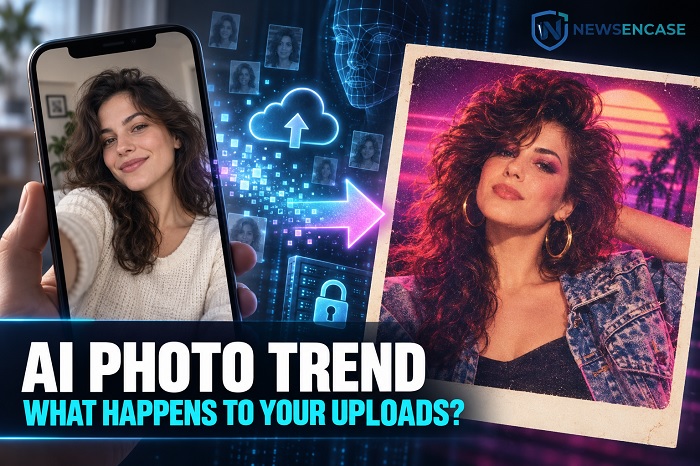
The viral ’80s-style AI photo trend is transforming ordinary selfies into nostalgic portraits featuring retro fashion, vintage hairstyles and cinematic backdrops. While the finished images may disappear from social media feeds within days, the original photographs uploaded to AI platforms may remain stored for much longer.
The trend has attracted celebrities, politicians and millions of social-media users. However, privacy experts are urging people to understand what happens when they submit personal photographs to an AI chatbot or image-generation application.
What happens after you upload an image?
An AI platform must transfer the photograph to its servers and analyse its contents before producing the requested transformation. The picture may reveal more than a person’s appearance: backgrounds can expose homes, workplaces, schools, vehicle numbers, documents or other people.
Image files can also contain metadata such as the date, device model or location where a photograph was taken, although some platforms remove certain metadata during processing.
The uploaded photograph, prompt and generated result may then remain associated with the user’s conversation or account. How long they are retained—and whether they can be used to improve AI models—depends on the platform, account type, privacy settings and applicable policies.
Retention policies differ across platforms
OpenAI says content submitted through its consumer services, including images and files, may be used to improve model performance when the relevant setting is enabled. Users can disable “Improve the model for everyone.” Temporary Chats are not used for model training and are automatically deleted from OpenAI’s systems within 30 days, subject to limited safety or legal exceptions.
Google’s Gemini Apps Privacy Hub states that activity is automatically deleted after 18 months by default. Users can change the period to three or 36 months, turn activity storage off, or manually review and delete saved activity.
Anthropic says that when users permit their Claude conversations to be used for model improvement, de-identified data may remain in training pipelines for as long as five years. Different rules may apply to deleted conversations and content retained for security, legal or policy-enforcement purposes.
These policies do not prove that an uploaded ’80s-style portrait will be leaked, sold or misused. They do mean that creating a viral image involves sharing personal data under the chosen platform’s rules.
How to protect your privacy
Before uploading a photograph, users should check the platform’s retention and model-training settings. Temporary or private modes should be considered for sensitive content.
Avoid photographs containing identity cards, addresses, financial documents or confidential workplace information. Images of children or other people should not be uploaded without permission. Users should also delete conversations and files they no longer need and exercise extra caution with unfamiliar third-party AI applications.
The ’80s portrait may be temporary entertainment, but uploading the original photograph is still a data-sharing decision.
About the Author