
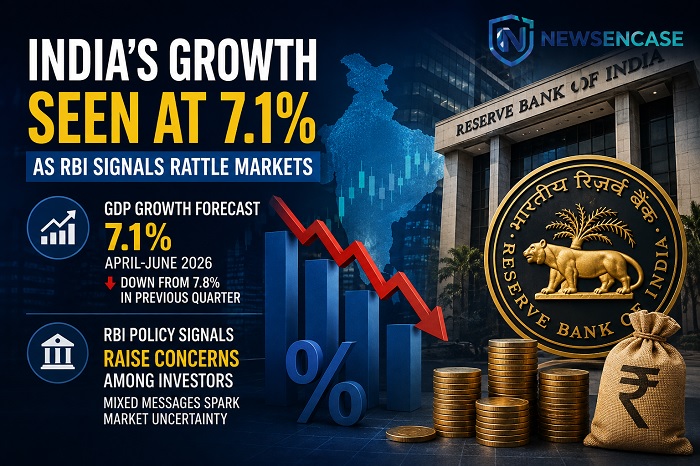
India’s economy is expected to remain the fastest-growing major economy, although growth likely moderated in the April-June 2026 quarter as elevated crude oil prices, geopolitical uncertainty and subdued private investment created fresh challenges. At the same time, the Reserve Bank of India’s (RBI) recent policy communication has drawn scrutiny from investors over what some analysts see as mixed signals.
According to a Reuters poll of 58 economists, India’s gross domestic product is estimated to have expanded 7.1% year-on-year in the April-June 2026 quarter, slowing from 7.8% in January-March. Official GDP figures are still awaited, making the 7.1% figure a forecast rather than a confirmed growth rate.
Consumer demand and government spending are expected to have provided support, while private investment remained relatively subdued. India’s external sector has also shown strength: government data estimates total merchandise and services exports at $232.73 billion during April-June 2026-27, up 11.37% from the same period a year earlier.
However, crude oil prices above $90 a barrel represent a significant risk because India imports more than 85% of its oil requirements. The rupee’s depreciation, geopolitical tensions and weaker business confidence could also weigh on the outlook. Economists surveyed by Reuters expect growth to moderate further to around 6.6% in the July-September quarter, with FY2026-27 growth averaging about 6.7%.
RBI Communication Draws Market Attention
Alongside the growth outlook, investors are closely watching the RBI after a series of policy signals created uncertainty in financial markets.
The central bank recently ended a dollar-deposit initiative earlier than markets expected, despite previous indications about its duration. Reuters reported that stronger-than-anticipated foreign-currency inflows may have contributed to the decision. Minutes from the RBI’s August policy meeting subsequently appeared more hawkish than its post-meeting communication, prompting analysts to flag a perceived disconnect in the central bank’s messaging.
Currency management remains another focus. On August 25, the rupee was trading around ₹95.7 per US dollar, with traders reporting likely RBI intervention to limit further weakness amid elevated oil prices and corporate dollar demand.
Despite these headwinds, India’s domestic demand and export performance continue to provide resilience. The coming official GDP release and future RBI policy decisions will be closely watched for clearer signals on the economy’s trajectory, inflation risks and interest rates.
About the Author