
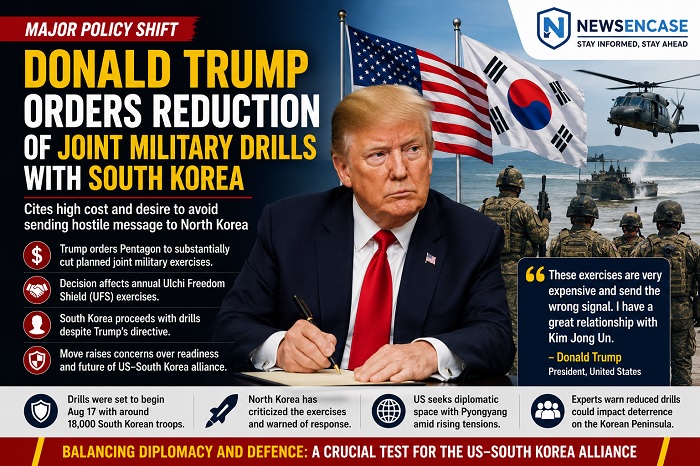
Donald Trump orders the Pentagon to scale back US-South Korea military exercises, citing costs and concerns over tensions with North Korea.
Washington/Seoul: US President Donald Trump has ordered the Pentagon to substantially reduce planned joint military exercises with South Korea, citing the cost of the drills and arguing that they send an unnecessarily hostile signal to North Korea. The decision comes as Washington seeks to maintain diplomatic space with North Korean leader Kim Jong Un.
The directive affects the annual Ulchi Freedom Shield (UFS) exercises, a major US-South Korea military readiness drill designed to prepare allied forces for potential threats from North Korea. The exercises were scheduled to run for 11 days beginning August 17, with about 18,000 South Korean troops expected to participate.
Trump Cites Cost and North Korea Tensions
Trump said the exercises are expensive and argued that they could send an inappropriate message to Pyongyang. He also pointed to his relationship with Kim Jong Un as a reason for reconsidering the scale of the military exercises.
The US president additionally expressed frustration with South Korea over its decision not to participate in US efforts related to the denuclearisation of Iran, adding another layer to the latest dispute between Washington and Seoul.
South Korea Continues Exercises
Despite Trump’s announcement, South Korea proceeded with the military exercises as scheduled. The drills are intended to strengthen combined defence readiness and allow US and South Korean forces to practise responses to complex security scenarios.
The exercises include command-and-control activities and training designed to address evolving threats, including cyber and drone warfare. US military officials have stressed the importance of maintaining readiness as North Korea continues developing its nuclear and missile capabilities.
North Korea has historically condemned US-South Korea military exercises as preparations for an invasion. Pyongyang recently criticised the upcoming drills and warned of a strong response, while North Korea has also continued ballistic missile testing.
Concerns Over US-South Korea Alliance
The decision to scale back the exercises has raised concerns among some security experts and US lawmakers, who argue that reducing joint training could affect military preparedness and deterrence on the Korean Peninsula. Critics also question whether a reduction in exercises could encourage North Korea to take a harder position rather than move towards negotiations.
For Washington and Seoul, the challenge now is to balance military readiness with diplomatic engagement. While Trump has signalled an interest in maintaining dialogue with Pyongyang, North Korea’s advancing military capabilities continue to remain a major security concern for South Korea, the United States and their regional partners.
The latest move could therefore become an important test for the future of the US-South Korea security alliance and Washington’s broader strategy towards North Korea.
About the Author